• Skip to main content
  • Skip to footer

F. P. Dorchak

Speculative Fiction (New Weird) Author

  • Home
  • Books
    • What Readers Are Saying
  • Short Stories
  • About
  • Blog
    • Runnin Off at the Mouth
    • Reality Check
  • Events
  • Contact

Books

What Ever Happened to Book Editors?

May 15, 2015 by fpdorchak

Do It Right. (Tacoma Narrows Bridge, by RustyObjects {Own work} [CC BY-SA 3.0 {http://creativecommons.org/licenses/by-sa/3.0}], via Wikimedia Commons)
Book editors.

We all have images in our heads of what they are. What they do.

But are our images correct?

Marjorie Braman’s article, “What Ever Happened to Book Editors” got me to remembering the first time I’d ever heard about the real working lives of publishing editors. It was at a writer’s conference. From the very editors themselves. What I’d heard sounded more like my own work life (minus the specific book stuff)…meetings, meetings, and more meetings. Budgets. Schedules. Reading queries. Writing flap copy—oh, and trips.

I didn’t hear a whole lotta editing going on in those offices.

Now, they did tell us that any editing they did they had to do on their own time…at home. After looong days at work. So, they had that going for their job descriptions.

But what Marjorie’s article brings out is that publishers believe it’s all about acquiring and selling. She was flat-out told by her publisher at the time—as she says, “almost in passing”—that “We don’t pay you to edit.” She says that one little quip meant to her (and rightly so, as I’ve gathered over the years I’ve experienced being in the publishing world) was that editing is no longer important. It’s all about buying and selling. She says this has been true since she came into the business in 1985.

This date, I found curious.

You see, I started getting serious about writing around that time (May of 1987). I still have my original log books—see, I even started treating it as a profession back then…doing it every day, studying it, going to critiques groups, keeping track of all my work.

But, man, talk about being a day late and a dollar short in an industry where editors were editors and authors were cultivated!

On the flip side to Marjorie’s article is that she became a freelance editor and left trad publishing, so all of the above no longer applied to her. Now…she’s full-bore into helping authors write the best books possible.

But what she’d described above is what I’m seeing everywhere: the constant focus on the bottom line to every business. It’s all gone to bean counting. Bean counters are even making heady corporation direction decisions, all based upon what’s making money and what’s not. That’s not a good perspective. A good perspective would be the overall picture/health of a company and what needs to be reworked…sometime a “minor” correction in one department can generate huge, positive outcomes (yes, even positive revenue generation) elsewhere. It’s not just a “this makes money and this doesn’t.” What is working and what isn’t…how can we improve processes…more intelligently schedule…make better use of existing capabilities…make a better product/give a better service…and the rest will follow?

How can we publish better books?

Better cultivate authors?

Not just sell crap cause crap sells?

If all you have is crap (or “the same old thing”) available…that’s all anyone can buy. If you don’t challenge people, they do not grow.

A fair cost-benefit analysis (again, I find this different and more in-depth and useful than a mere “this makes money…this doesn’t…” indignance).

Just how much of a profit is really needed for an industry to survive?

Hire the people you need…staff the actual positions with qualified individuals…cultivate better authors…and let editors do what editors are supposed to be doing. I know all this “costs.” So do books. And there are other options out there for readers…for writers.

My dad always used to say, if you’re gonna do something…do it right, for God’s sake.



Filed Under: Fun, Leisure, To Be Human, Writing Tagged With: authors, Books, Editors, Publishing, Writers

To Blog or Not To Blog a Novel

April 8, 2014 by fpdorchak

By Camdiluv, from Concepción, CHILE (Colours) [CC-BY-SA-2.0 (http://creativecommons)
I say “novel,” but it could just as well be a short story.

I’m going to try to make this short and sweet.

There are all kinds of advice floating around about whether or not one should or shouldn’t blog out portions of one’s work into the Internet…how it might or might not damage the success of said work, should the blogger want to publish it, en masse.

Dare I say it?

Bullshit.

To that I add: pure bullshit.

A member of the writing I belong to expressed concern about that, because that was what this member was doing…then had stopped…but was, again, considering doing. He did it because of several reasons, some of which were that he enjoyed doing it. It got him writing. He’d found an audience.

I’d say the following be my opinion, but I really don’t think it’s an isolated “opinion” anymore. Heck an opinion at all; it has become fact: As long as what you do doesn’t hurt anyone, do what you love. Do what you enjoy. There are always people out there who love serials…and those who would love to read those serials again…or in one complete form. Those who have never seen your work, so one platform or the other serves them.

Do you really think a traditional publisher is going to care whether or not you blogged about your work–if they really felt they could make millions of you?

Hell no.

Any free promotion they can get to help sell their version of your work, all the better.

Look, no trad publisher is gonna take you if they don’t feel they can make a buck off of you, period. Your blogging of your book is an antiquated issue, based upon antiquated reasoning. Antiquated reasoning is what’s damaged (and continues to damage) traditional publishing. Reasoning can be made for or against anything, but it’s all about packaging. Look at all the crap out there that’s been out there for ever, suddenly repackaged and re-promoted. Instead of bitching and moaning about what not to do, about how terrible the world is and how things “could never work,” why not spin that frown upside down, my perfectly bound friends? Anything can be sold. Just put out a little effort, for crying out loud.

And you can always, always, Indie publish (don’t even get me going about how Indie publishing merely promulgates more shitty work into the world).

Do what gives you joy.

It’s your life.

Live it as you want. If your work is good or meant to succeed–in however way you define it—it will.

Just ignore all the white noise out there, and do what makes you happy. Life is short. Play hard.

To “he” out there, you go, dude! Have fun and keep your audience wanting more!

Related articles

  • Wailing Loon (fpdorchak.wordpress.com)
  • Going Indie – What I’ve Learned (So Far) (fpdorchak.wordpress.com)
  • Going Indie – What I’ve Learned (So Far) – Part 2 (fpdorchak.wordpress.com)
  • Going Indie – What I’ve Learned (So Far) – Part 3 (fpdorchak.wordpress.com)
  • Going Indie – What I’ve Learned (So Far) – Part 4 (fpdorchak.wordpress.com)
  • Going Indie – What I’ve Learned (So Far) – Part 5 (fpdorchak.wordpress.com)
  • Going Indie – What I’ve Learned (So Far) – Part 6 (fpdorchak.wordpress.com)
  • Going Indie – What I’ve Learned (So Far) – Part 7 (fpdorchak.wordpress.com)
  • Going Indie – What I’ve Learned (So Far) – Part 8 (fpdorchak.wordpress.com)
  • Going Indie – What I’ve Learned (So Far) – Part 9 (fpdorchak.wordpress.com)


Filed Under: Art, Leisure, To Be Human, Writing Tagged With: Blogging, Books, Indie Publishing, Joy, Novels, Publishing, Serials, Short Stories, writing

A HUGE Thank You To All of You!

February 24, 2014 by fpdorchak

By Erkan Yilmaz (Own work) [Public domain], via Wikimedia Commons
I just wanted to give a heartfelt THANK YOU to everyone who has taken the time to visit my sites (here, Facebook,  About Me, LinkedIn, Twitter, Pinterest), read and review my work, or to mention any of this to another. In interacting with me on social media (oy, and trying to stay up and current on all this social media while working a day job, trying to WRITE, living a regular life…?!).

It is still weird to me, as long as I’ve been writing, the whole promotion thing…focusing attention on me…so, I look at it more as focusing attention on the work (I even have a hard time saying my work!). The books, the stories. These are things people like me like to say we “channel,” or sculpt into existence. Like a wood carver “discovering” the shape that “forms” out of tree trunks or limbs. We shape things. I suppose we all do it for different reasons, like entertainment, enlightenment, cathartic release. I’m sure you’ve heard it all before. Whatever the reason, we just do it. It’s what’s “built” into us…mechanics are drawn to oil and machinery and athletes to their sports. We’re all drawn to something in our lives. Writers/artists are no different. But in our case, without you, we’re only halfway there. To write is to be read, and I am ever grateful for you being on our team, because it is a team.

I appreciate that you’ve taken time out of your day to spend a little of it with people like me to read, comment, discuss, commiserate, what-have-you. There’s a lot going on out there, and I’m very appreciative of everyone’s time and efforts, and I periodically like to let you all know that I try to take very little for granted…especially my readers and support group—YOU.

Thank you!

Filed Under: Art, Leisure, To Be Human, Writing Tagged With: Appreciation, Books, literature, Novels, reading, Short Stories, Thank You

ERO—The Press Release

July 19, 2013 by fpdorchak

Is All We See...Real? (Photo credit: Wikipedia, Apollo 8 crewmember Bill Anders, December 24, 1968)
Is All We See…Real? (Photo credit: Wikipedia, Apollo 8 crewmember Bill Anders, December 24, 1968)

Here is the press release for ERO (click here). I used PRLog. The PR should be visible on their main page for a little bit today.

I’m releasing the book on July 20th, tomorrow, to time it with the 44th anniversary of the Apollo moon landings. Just for fun. I’m sure somehow I’ll be tagged as part of the conspiracy theory and treatises will be written about my involvement in promulgating the hoax of our lunar landings through the highest levels of government….

At least, a writer-selling-novels can only hope!

Take everything with a block of salt, readers.

Only real thing I realized after submitting I could have done better, is including a larger image of the book I attached to the PR. Dang it. Well, the PR does give an expanded view of the cover.

Can you all keep a secret? I might begin uploading files late tonight, so it might actually go live slightly early, Mountain Time, though it’ll be July 20th, Eastern Time. Shsssh. This is on a strict, need-to-know basis….

Join the confusion. Question everything. Nothing is as it seems.

Related articles
  • ERO Cover is on a NTK Basis…. (fpdorchak.wordpress.com)
  • The Music of ERO (fpdorchak.wordpress.com)
  • ERO – The Research…and the Truth (fpdorchak.wordpress.com)

Filed Under: Fun, Leisure, Space, Technology, To Be Human, UFOs, Writing Tagged With: Apollo, Apollo 11, Apollo 11 Moon Landing, Books, ERO, Exoatmospheric Reconnaissance Organization, F. P. Dorchak, fiction, Hoaxes, July 20th, Novels, Press release

Cover Artist Lon Kirschner Interview

June 19, 2013 by fpdorchak

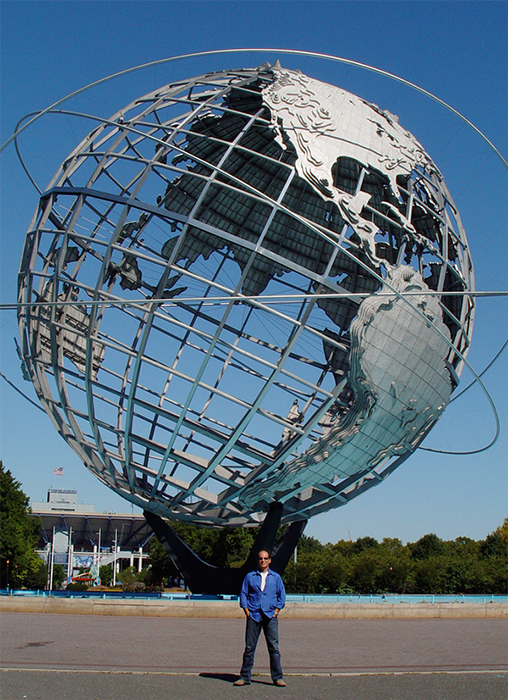
Lon Kirschner at The Flushing Meadows-Corona Park Unisphere (Courtesy of Lon Kirschner)

I love this guy’s work.

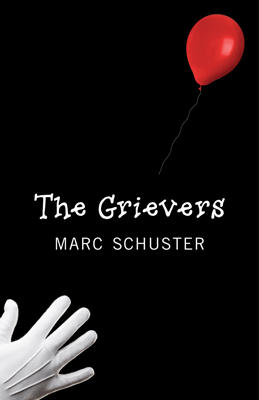
I “met” Lon Kirschner through author Marc Schuster, who had just published his novel, The Grievers. In my review of The Grievers, I had said, first line out of the gate,  “He had me at the cover.” And that was true. As soon as I saw the cover, I knew I had to read it, so I contacted Marc, and later Marc had connected me with the cover artist, who was Lon Kirschner (Lon works with his wife and business partner, Nancy Potter; examples of  his work are included in this interview). I’d since come to discover his website (Kirschner Caroff) and some of his work , we traded e-mails, and I thought, what a cool guy. Lon had told me that my review was the first time he’d ever been mentioned in a review. That kind of startled me. I thought—heinous! But the way his Grievers cover grabbed me shows the power of a well-made cover. I knew absolutely nothing about the story at that point (you know, we see covers first), but figured the “tone,” the message of the cover, was so superbly crafted that the story had to be well-written and quirky (I was not disappointed)! Covers get all kinds of boon and bane, why aren’t cover artists more frequently discussed—interviewed? That’s when I decided I had to interview this guy.

Lon could you give us a short bio on yourself?

My favorite bio is by Charles Davis, a wonderful author (who coincidently, I have done several

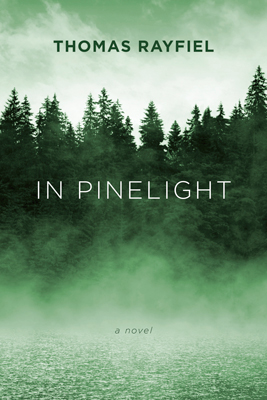
In Pinelight, by Thomas Rayfiel

covers for).  His bio reads:  “Charles Davis was born and educated, and has traveled and worked. He now lives and writes.”

Taking his lead, here goes:  Lon Kirschner was born and educated, and has traveled (a bit) and works (and works).  He now lives (thankfully) and designs.”

Hmm… I suppose you want more.

I was born in Queens, NY. A short walk to the 1964 World’s Fair grounds. The Unisphere is without a doubt my favorite piece of NY architecture. Growing up I loved to draw and knew that art was something I wanted to do. This was in spite of a crabby elementary art teacher telling me that even though I was good in art didn’t mean I could make a living at it. So much for early education!

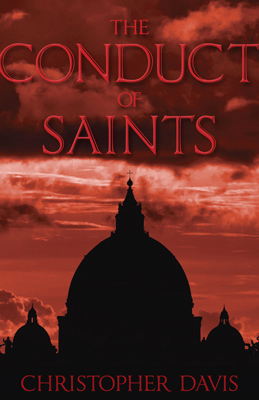
The Conduct of Saints, by Christopher Davis

I applied to several art colleges with my dream choice being The Cooper Union. A wonderful school with a long history of producing extraordinary designers and illustrators (what was I thinking?). Upon acceptance, each student was presented with a 100% tuition-free scholarship (what was I thinking?), a legacy that has existed since 1859 but is now sadly changing due to a difficult economic climate.

To my utter surprise I was accepted!  After graduation I started as a lowly studio assistant and worked my way up to a slightly higher level of lowly studio assistant at a small boutique studio in New York City. After 3 years I felt it was time to strike out on my own. I gave up a steady paycheck and began freelancing. After several years I joined with my old employer and we ran the studio together. Over the years, he played less of a roll until he retired.

I met my wife Nancy Potter, who was working at the studio when I returned. Together we have maintained the business as partners and have adapted to the vast technological changes in the industry.

When and how did you get into graphic design? Was it something you just always knew you wanted to do? Does artistry run in the family, and if so, how far back does it go (I love histories!)?

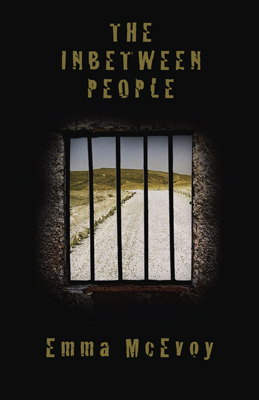
When I first got into the business, I wanted to be an Illustrator. I found typography a bit overwhelming and thought that it would be

The Inbetween People, by Emma McEvoy

nice if all I had to do was draw pictures.

Reality set in, I needed a steady paycheck to cover my bad habit, playing drums in a rock and roll band. This required paying for rehearsal studios and gas to get to and from rehearsals and gigs. We were getting paid but you can’t pay bills on “all the beer you can drink.”  When it looked like the big record deal wasn’t happening it was time to move on and start building my career in art.

My day job was at a studio that produced graphics for a very broad group of clients, including assignments for movie campaigns, corporate identity, logos, packaging and publishing. I had learned a great deal and my typography phobia was alleviated. I was ready to put down my drumsticks and concentrate on graphics.

You asked about artistry in my family. My mother’s sister is a very talented person. She was a singer and also paints, draws and works in various media. If there was a connection to anyone in the family as far as “art” is concerned I would say that is it, but it all depends on what you consider art. My grandmother and mother were fantastic cooks. They could open a refrigerator (I would see an egg and some capers) they would see the makings of a five-star meal. When I think back on that there was definitely an element of art involved. Art can come from anywhere.

Excellent point, Lon! “Art” is not just about graphics and typography…it’s also about eggs and capers! What is your earliest memory of the first manifestation of your talent?

Drawing pictures with my friend in first or second grade. Cowboys and Indians and army battles. Other kids played them, we drew them.

Love that last sentence! What medium do you prefer to work in?

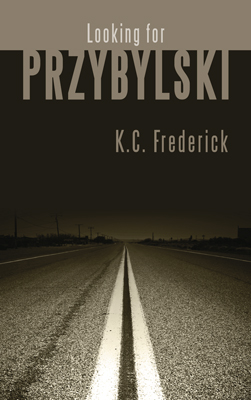
Looking for Przybylski, by K. C. Frederick

When I started in the business, it was all paint, pencils, rubber cement and razor blades. I was big on airbrushing but not so big on wearing my protective mask. Refer back to my answer for the bio question “He now lives (thankfully),” I must have inhaled gallons of dyes, acrylics and whatever else I could manage to spray. I was young and didn’t think about it.

Now it is all computer. It’s great to be able to set my own type, composite photos, produce comps that look printed and send files all over the world. The bad part is that many people (dare I say clients) think changes are simple and can be made at a moment’s notice. This gets into the whole concept-versus-production question. Don’t get me started. I see in the later questions that I will get my chance to state my case. If I sound to whinny, feel free to edit. No one will know (except me).

When and how did you get into book covers?

When I started freelancing, a friend of mine from college was working in the art department at Simon and Schuster. She told me I should come up and meet the art directors that gave out the assignments. I looked through their catalog and picked a few titles that I thought had less than inspired covers and redesigned them. I went up with my new book cover portfolio and landed some assignments. Most of these were in the “How To” genre, but I was happy to get the work. Another friend was working at Viking/Penguin. She invited me up to meet the creative director. I brought some of my airbrush paintings with me. He liked the work and handed me a rather long manuscript for a new book by an unknown author. The book was The Broom of the System, the first novel by David Foster Wallace. I did the cover illustration, the type was handled by their in-house art director. The cover was produced simultaneously as a dust jacket for hardcover as well as a paperback. I have the paperback, the hardcover was a limited run of 2,000. You can find them on ebay selling for fairly high prices.

How cool! You have pedigree! Could you describe your process for creating a cover?

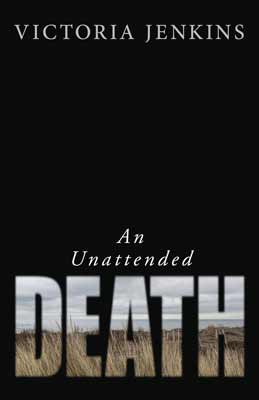
An Unattended Death, by Victoria Jenkins

My design process for a book cover is fairly simple. I read the entire manuscript, if it is available. I then think about it for a while and then I start working. Many times where I started is not where I wind up. There have been happy accidents that take me in a whole new direction. The basic concept may be the same as when I started but the visual is totally different than what I originally had in mind. The truth is, most often than not I get an idea somewhere along the way, as I am reading. If it comes early I keep reading because there is always the chance that the idea won’t work out. People have commented to me that I really don’t need to read the entire book, a brief will do. Sometimes that is true, but I find more often than not ideas that come from a full manuscript would never have materialized if I had just read a few descriptive paragraphs. Books are like people, you need to go the distance before you really know them.

My goal is not to illustrate a particular scene in the book, but to convey a sense of what the book is about.

I’m quite impressed. So much of today is hurry up, do it yesterday, speed x 3! It’s nice to see you put in the in-depth interest, analysis, and effort. I’ve heard of so many dissatisfied authors, when it comes to their covers….

Okay, Kirschner Caroff is a full service graphic design and consulting company. You’re not “just” about book covers. You do all kinds of work: packaging, “corporate identity” work,  movie posters, logos—can you explain a little about them, and if the processes for any of them is any different between them?

As a small studio we tend to “specialize” in all types of work. I have learned over the years that basically all design projects share

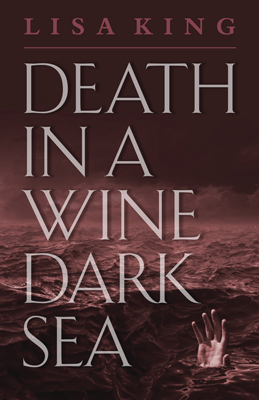
Death in a Wine Dark Sea, by Lisa King

something in common. If they are going to be successful, they need to be built on a concept. Of course execution is important, but if the concept is lousy, the best execution won’t make it a good design. In our digital world where everything and anything is possible I feel that this crucial concept is sometimes forgotten.  My philosophy is keep it simple, keep it focused. Communicate in the least complicated way you can. We are in the business of communication. If your audience doesn’t get the point, you failed. It would be like writing a book in Russian for an English speaking audience.  Not everything needs a special effect. In fact, in a world gone special-effects crazy, sometimes it is the simple things that make the greatest impact. I am all for effects and digital magic if they enhance the design. We all know you can put a monkey’s head on a man wearing a suit and make it look real. If that’s the right solution for the job go for it. If not, rethink it. I myself have put a few weird things in a suit, but I think I was justified.

Less is more! That was one of the reasons your cover for The Grievers really grabbed me! Such powerful subtlety! Is there a different process when working with a publisher than when you directly freelance with an author?

The process of working with an author is very different than working with a publisher.  An author has a very personal relationship with their work. They have thought about it and worked on it for possibly years. They are so close to it that it is sometimes difficult for them to take a step back and look at it in a different light.

Many authors have  ideas that they think are perfect, but in reality they might not be the best solution. I listen and see if there is something I can use, but if not, I go my own way and do what they have trusted me to do. It usually works out. In fact I can say it

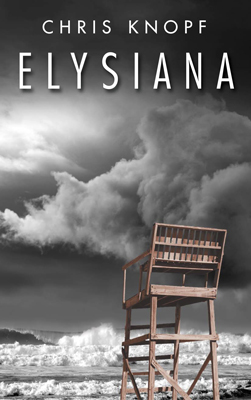
Elysiana, by Chris Knopf

always has worked out. I have had a few rough ones along the way, but in the end, solutions were always found. There have been times when an author makes a suggestion that takes a concept from being a good solution to a great solution. I try to leave my ego at the door and listen. If a suggestion is made that may work, I am happy to try it.

Publishers are easier because there is less emotion involved. The cover I am working on for them is one in a long list of projects they need to get done. There isn’t the same personal interests. When you work for a small press, many times the author does get involved. I have met some very extraordinary and wonderful people over the years, I actually consider it a benefit of the job.

Great point, the contrast between authors and publishers. How did you get to work for Permanent Press (or any other publisher)? Can you give us a list of some of the other publishers you’ve worked with?

I sent out a printed mailer to about two hundred publishers that looked interesting. Mostly fiction. Martin Shepard (Permanent Press) called me in response to the promotion. We had a great conversation, he explained he was a small publisher and probably couldn’t afford it. I asked him what his cover budget was. After he answered I told him he was right, he couldn’t afford it. The problem was I got such a good feeling from him that I made him a proposal. I told him if he could send several books from his list I would do it. The old make-it-up-in-volume approach. He agreed and that was the beginning of a twenty-plus-year relationship. As the years went by, I got more books per list. I am now the de facto Permanent Press Creative Director/Art Department.  I now do around sixteen books a year for them.

Over the years I have worked for Bantam/Doubleday/Dell, Simon and Schuster, Viking/Penguin, Paragon House, Northwestern University Press, Aldin DeGruyter and a host of smaller independent publishers.

What’s your typical work day like?

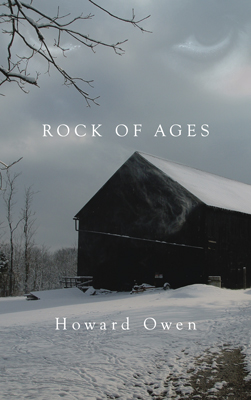
Rock of Ages, by Howard Owen

There is no such thing as a typical day. You can sit down to work and think you have your entire day planned and then the phone rings and everything goes out the window. It’s the nature of the beast.  Feast or famine.

Rock and roll! Are there other forms of expression: a) you’re already doing, and b) you’re not, but would like to do?

My first love was illustration, but I seem to have gotten further and further away from it. A lot of the solutions tend to be more photo illustration. I would like to get back to doing artwork in a more traditional manner, or maybe a combination of digital and traditional. I still dream of doing an illustrated children’s book. It doesn’t even matter if it sells. Just completing that goal and having it done would be a very satisfying experience. I have several ideas and partially written manuscripts that no one has ever seen. It’s my secret. I love doing what I do, but having a book of my own would be very special.

Hmmm…ever consider indie publishing, or Creative Memories? I know a great Cover Guy…

What do you like to read, currently reading?

I like to read fiction. Things that take me away from the everyday. I love mysteries. I am currently reading one by P. D. James. I also enjoy the broad sweeping historical novels. I have Sarum, by Edward Rutherfurd waiting in the wings. I read London and really enjoyed it. I actually was reading it while we were on a UK family vacation last summer.

What do you feel is the [real] impact of cover art [on readers? Publishers? Buyers? Authors]?

Many years ago the creative director of Bantam books told me that if he could get a person to pick a book up in the store based on the

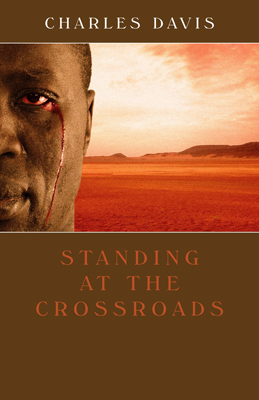
Standing at the Crossroads, by Charles Davis

cover then he had done his job. He couldn’t walk that person to the cash register, but by getting them to pick the book up the first part of the buying process had begun.

In the digital age the concept is the same, you still need to grab a reader’s attention. This is what authors and publishers expect and want. I feel covers are just as important now as they ever were, maybe even more so. Delivery methods come in all forms, but whether it is print, tablet, computer screen, or e-reader, a cover still needs to be impactful and compelling to the reader. If this weren’t true, all you would need for a cover would be a black-type title on a white background. A book cover is part of the whole package. It is the package. Sometimes the first impression a reader will have of a book will be based on the cover.

The internet has changed the way we buy books. When I am at an online site to buy a specific book, I very often see a cover that looks interesting and click on it to get more information. I have bought many books because the cover caught my attention. I may be a little more critical than others, but I think it works the same for everyone.

So, you can judge a book by its cover! How many projects do you have going on at any one time?

It varies. Right now I have about 13 or 14 books that need to be finished by the end of the summer in addition to some other corporate

work. The problem has always been that you think you will get to something and then another project with an earlier deadline comes in, you have to put something aside to get another project out the door. It’s all about time management. I am proud to say, the studio has never missed a deadline. We’ve missed some sleep, but never a deadline. This is a service business. You can do great work, but if you miss the deadline it doesn’t matter, you’ve produced the greatest design that no one will see.

Go on, Lon, get Zen, in any way you feel necessary about your business/efforts/work!

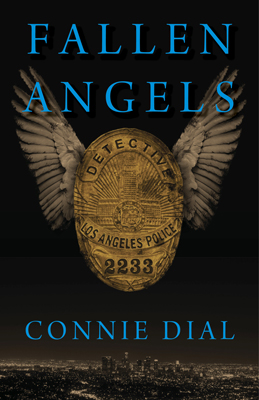
Fallen Angels, by Connie Dial

I love what I do. The wonderful part is that it is never quite the same. Each project is different and requires a unique solution. Some are not as exciting as others, but every project requires you to think differently. I don’t go to work every day and push the same piece of paper around. Some days are harder than others but that is probably the same for everyone no matter what they do. I produce something that is unique to me.

I still see things I designed years ago; it’s a very satisfying feeling. This past year we received an inquiry from The Canadian Museum of Civilization asking about using the cover art from The Magic Island as part of an exhibit on Voodoo. It is running now at the museum and will then travel throughout North America. That was a great feeling. I painted that cover many years ago using airbrush and traditional production methods. It won a Society of Illustrators award the year it was produced. After all the time that has gone by it’s exciting to see it have a new life and still remain a relevant design.

I am always happy to speak to people about possible projects. It’s part of what makes this exciting. You never know what the next call will bring.

Lon, if you were to have a gravestone, what would you have engraved upon it?

I hope I will have a gravestone or something to let the world know I was here. I think it would read:  “There’s never enough time in the day.”

Thanks for your time, Lon! And I look forward to working with you on the cover for my next release, ERO!

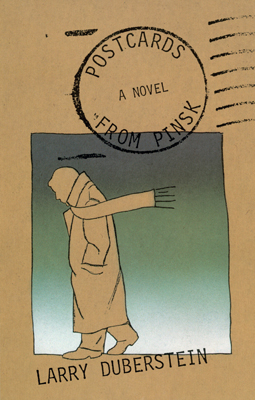
Postcards from Pinsk, by Larry Duberstein. First cover Kirschner Caroff did for Permanent Press
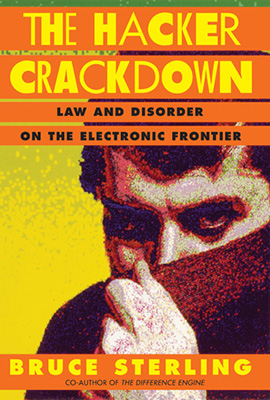
The Hacker Crackdown, by Bruce Sterling. First PC-generated Cover by Kirschner Caroff.

And…he had me at the cover:

The Grievers, by Marc Schuster. My introduction to the
The Grievers, by Marc Schuster. My introduction to the world of Kirschner Caroff!

To contact Kirschner · Caroff Design Inc., for freelance:

Phone: 518/392-3823

E-mail: info@kirschnercaroff.com

Website: http://www.kirschnercaroff.com/section-pages/contact.html

Filed Under: Book Covers, Fun, Leisure, To Be Human, Writing Tagged With: Art, Book cover, Books, Cooper Union, Cover Art, Cover Artist, Graphics artist, Kirschner Caroff, Lon Kirschner, Nancy Potter, New York City, Queens, Unisphere, Visual Arts

Promotion vs. Promotion

March 10, 2012 by fpdorchak

Spy vs. Spy
Image via Wikipedia

Such an ugly word to some, choiristic (that a word?) angels and bright lights to others. But a genuine concern to anyone who has anything to sell.

How much is too much?

Just yesterday a friend and I exchanged an e-mail on why some booksignings may or may not be getting the quantity of people to them they used to in the past. The topic arose about social media. That now, on Twitter,  Facebook, and you-name-it, everyone knows about everyone’s nosepicking, butt-wiping, teeth brushing habits, so there’s little left to the imaginaton…little mystery left to authors. Many claim social media the cure-all to selling anything, others, like The Red Pen Of Doom, decry diametrically. I am somewhere in the middle, but basically subscribe to the notion that it’s all “word of mouth.” Pick your platform, pick your poison, but I feel it doesn’t necessarily matter what your poison is, if it’s at all interesting to anyone, it will sell. I also believe in the Zen of life, and that applies to everything (so there’s always a Zen reason for why anything may or may not succeed as the owner may wish it to, and that trumps most of this discussion…). Sure, it has to get out there, but that’s where one’s poisonous platforms come into play. Once it’s out there, there simply has to be interest, and I feel basic “backyard clothesline telegraphy” can get the job done just was well as any TV advertisement, YouTube, or tweet. Because it all comes into play when people are interested in anything.

So, while I agree with much of Mr. Red Pen, and greatly like what he has to say, I disagree in that anything can sell anything. There just has to be some kind of a fire lit under it. And I can’t tell you what that fire is. It could your burning wit, your good looks, your eloquence. Your tireless promotional energy. Yes, it could still be Oprah.

Hell, it could even be your powerfully delivered story, characters, and message.

Now, I’m a huge fan of mystery. I realize long ago, I don’t really and necessarily want to know a movie star’s political alignment, nor an author’s brand of toothpaste. We all have our quirks and weirdness, and I don’t think we need to broadcast every little thing about ourselves. I love the imagination, and I love to What-if. I think we all need a little mystery left to our lives, left to our imaginations…these will help fire our imaginations. Imagination is important. It fuels pretty much everything about our lives. We imagine to do better, to go farther, to grow and improve. If every little thing about about every little thing is laid out bared and eviscerated, it can well kill (at the very least blunt) the imagination. An ability not used atrophies. It also takes away the fun, and there’s something to be said for experiencing more fun in our lives…perhaps now more than ever. Deadening our imagination takes away our ability to think for ourselves. Leave a little meat on the bone, for crying out loud, and let your imagination run wild, not your tweets.

So, in summary (I’m imagining myself before a packed lecture hall…), all I’m saying is, is that anything could sell your wares. Literally anything. And that we need to allow mystery back into our lives. Not always going for the explicit the minutiae inundated lifestyle that seems to have overtaken us. I hope to prove this in the near future, but it’s what I truly believe.

In the interests of promotion, I’ll be in Longmont, Colorado, April 13th, for an en masse booksigning at the Longmont Public Library. I’ll be signing my novel, Sleepwalkers. Hope to see you there!

Also, in interests of promotion, I’ve created a new blog site, called Reality Check. We’ve all had weird things that have happened to us throughout our lives, so I thought I’d try a new site to handle this stuff, which greatly interests me, ever since I was a wee lad, and which factors in my fictional work.  I’m preferring to make this a positive site, not about the dark and the nasty.  There’s enough of that out there. This site is about the GOOD in life. Please check it out!

Just had this epiphany after having posted this earlier today (and maybe it’s not new to you, but it just hit me while I was washing lettuce in the kitchen sink): what if the real secret to utilizing social media in selling anything is not so much sellers and authors using it…but customers? That it’s in the customers’ best interests to FB and tweet the hell out of their praise for an item, since so many get upset at people sell their wares on Twitter, by e-mail, and perhaps even FB?

Thanks for stopping by and thanks for taking the time to read my posts!

Filed Under: Leisure, Uncategorized, Writing Tagged With: Books, Promotion, Sleepwalkers, Social media

  • « Go to Previous Page
  • Page 1
  • Page 2
  • Page 3
  • Page 4
  • Page 5
  • Go to Next Page »

Footer

Upcoming Events

Events

Heading To

COSine 2026 – January 23 -25, 2026

Mountain of Authors – Unable to attend in 2026

MileHiCon58 – October 23 – 25, 2026


Follow Me

  • Facebook
  • Instagram
  • Pinterest
  • WordPress.org

Copyright © 2026 · Author Pro on Genesis Framework · Powered by WordPress.com. · Log in