• Skip to main content
  • Skip to footer

F. P. Dorchak

Speculative Fiction (New Weird) Author

  • Home
  • Books
    • What Readers Are Saying
  • Short Stories
  • About
  • Blog
    • Runnin Off at the Mouth
    • Reality Check
  • Events
  • Contact

New York City

The World's Greatest Writer

December 11, 2015 by fpdorchak

In One Page. By Infrogmation at English Wikipedia on en his/her summary,
In One Page. By Infrogmation (English Wikipedia on en his/her summary, “typewriter keyboard, from nl wikipedia”; http://www.pdimages.com/X0022.html-ssi, [Public domain], via Wikimedia Commons)
Enclosed is the really fake true story of the world’s greatest writer. You can’t get this story anywhere else—only from my scoop, and I’m willing to talk.

Wow, such hubris had I back in 2002 (I was actually trying to be funny, since this is the only intentionally funny story I’ve ever written)! I’d sent this to The New Yorker October 13, 2009, and the above was my opening line. I committed some other heinous atrocities in that cover letter I’ll not reveal, but, yeah, I’m sure I pissed of the editor and had my name put into some file of “Never accept anything from this person ever again. EVER.” Sigh. But I was trying to be “in form” for the submitted story. Probably explains why every other thing I’ve sent them fell flat. BTW, there are some definite publishing jibes in here that might also fall flat on those not in-the-know….

This story was originally published in Black Sheep #62, December-January 2005.

The World’s Greatest Writer

© F. P. Dorchak, 2002


“Well, have you ever actually met him?” the doe-eyed initiate asked.

“Uh, nooo, not actually,” the immaculately dressed author-in-white responded, “I’ve been told he’s rather a bit of a hermit, you might say.” The author-in-white nervously fingered his cane and white hat meticulously posed before him.

The young writer nodded thoughtfully, then added, “Okay. So, then, have you ever actually read any of his work?”

At this, the writer-in-white’s ego further deflated, upon which he grew visibly agitated. “Um, no, my dear, I haven’t yet had the opportunity. No one has—”

“Then how do you know he’s such a great writer?” pressed the young one, who held the older writer’s gaze firmly, her manuscript cradled loosely in her arms between them. The young one had not meant to pin the learned author to the wall, but was merely genuinely curious. “How can you say so much about him, when you haven’t ever read his work—or met him?” She furrowed her brow, patiently awaiting an esoteric, scholarly, response.

“I know it’s hard to believe, my dear, but it’s his reputation, you see. Did you know he doesn’t even use a computer? He uses a mechanical typewriter! The gentleman is simply… extraordinary. Exceptional. Have you ever personally met God? The Pope? No…you know of each through faith, through reputation. But that’s what this banquet is all about, my dear young one! He’s coming out, as it were! Don’t let your youth and impetuousness get the best of you! You are yet young—learn! Tonight, here, it is said that he will debut the opening pages to his Great American Novel! I mean, can you fathom this opportunity before you? The miraculous, metaphysical encounter we are all about to be granted? We are going to be the first to experience his words, his energy, his soul. His raw, unfiltered emotional fervor before they are all unleashed upon our common, illiterate, public—we…we are the privileged few. Savor this moment, my dear writer, for you clearly do not comprehend the enormity of greatness upon which you are about to witness. Mark my words: this…will never happen again. In any life time. My God, how I wish I were in your shoes, a lifetime ago, to start over my profession at a much higher place, indeed!”

And with that, the writer-in-white spun away on his heels from the neophyte in search of others with which to intelligently converse. The neophyte watched as the author-in-white discretely dabbed his eyes with a dainty white handkerchief, then quickly spirited it away, back into an inside lapel compartment.

Hugging her manuscript tightly into her chest, the young writer slouched off into a corner to ponder the learned man’s words, when another group of writers, editors, or agents made their way toward her no-longer-empty corner, though not inviting her into their conversation. After all, they did not know her and were too far along in their awe and adoration of I.M.N. Authier III, the unmatched, unparalleled, unequaled literary (and spiritual) prodigy to humanity who had emerged out of nowhere.

Well, Canada, to be precise.

Our young, impressionable writer overheard the entire story, as one of the group informed their newcomer on the miraculousness of what the author-in-white had just tried to impart upon her. This time, she heard…the rest…of the story:

There was not one person who could claim to have actually read a piece of Mssr. Authier’s work. Not even his agent. Mssr. Authier’s agent’s claim to fame was the divine opportunity of which she had been a part: the reception of his skillfully executed proposal package. So masterfully woven was it—and in less than one page—on the whitest and most defect-free twenty-pound paper with the cleanest, crispest TNR type that she immediately fell upon herself in a fit of hot, emotional blithering…which had so cleansed her being that her feline allergies had been summarily obliterated. Immediately, she’d called her estranged mother and apologized for everything cruel she’d ever done, or would ever do, including anything in all her future (or past) lives. Once she read her mother the letter, her mother likewise returned the compliment. The agent then immediately withdrew a sizeable portion of her investments and donated it to Readers Without Books and her top-two choices of battered parents’ shelters. Instead of staying home and reading through the rest of her slush pile, she flew out into the night to the nearest homeless shelter and spent the rest of the night assisting those who begged money for a living.

This, off the power of the esteemed Mssr. Authier III’s epiphianic proposal package (and on one page, no less!). Well, after she called Random House and read his poignant, moving letter to the company’s CEO, the CEO himself called Mssr. Authier, and offered him on the spot. He’d been very convincing. The CEO informed the esteemed Mssr. Authier III in no uncertain terms that if he didn’t take his offer, he was going to resign and take a bullet to the brain that very night. That it was his and his work alone that would make or break Random House—nay the entire publishing industry, sir!—and that it was his moral and spiritual imperative to not let Publishing fall.

Reluctantly, Mssr. Authier accepted.

Random House immediately put into motion a hundred-million-copy print run, foreign, movie, and audio book rights, and an emotionally blistering promotional campaign that rivaled D-Day’s 1944 invasion. Random House also sold a television series and coloring books for adults and children (grades one through four), to be included in the curriculum of all U.S. public schools. Europe was next.

Spielberg was awoken twenty-five minutes later and sealed an undisclosed multi-million dollar deal via The UPS Store’s faxes, securing Mssr. Authier’s signature. The exact fax machine used by Mssr. Authier had since been removed from service and bronzed.

Amazon.com took 110.3 million advance orders.

Mssr. Authier’s agent offered him her hand in marriage.

Dr. Phil asked Mssr. Authier for his advice on a secret, deeply personal matter that had been troubling him for years.

Phil Donahue disclosed a comeback to do one, really final this time, show with Mssr. Authier as the only guest.

Metallica penned a ballad in his honor.

So, as this new group of writers continued to chatter on about Mssr. Authier’s proposed deification, the neophyte found herself so emotionally overwhelmed, especially when certain lines from his proposal letter were refrained (now immortalized by the world and passed around like a veritable Internet Trojan and blowing up YouTube) that she found her soul uncontrollably expanding toward supernova detonation. And when she heard the title of Mssr. Authier’s proposed novel, she positively lost it and ran balling for the lady’s room, where she pulled out her meager manuscript and stared at it in weary, disillusioned judgment.

WWJD?

WWXD?

She grabbed her manuscript in both hands, her heart heavy with all the wasted time and effort she’d poured into this piece of no-name tripe, and viciously and maliciously began rending it into tiny, jagged, tear-stained shreds, amid spastic grunts and shrieks of soulless despair, tossed it into a pile in the middle of the lady’s-room floor, setting it afire.

The young neophyte then, amid the billowing smoke, floating ashes, and now-activated sprinklers of her snuffed manuscript, pulled out a pair of scissors and the razor she always carried, because she was, by trade, a hairstylist, and immediately set about shaving her head and carving Mssr. Authier’s initials into her scalp.


As the clock ticked closer to Mssr. Authier’s scheduled appearance, the entire Radio City Music Hall buzzed over his other ideas for other books. How could he possibly have created a series out of this concept, they asked? Surely his first book would drain everything a reader had to offer? Could a person emotionally survive the first book? Could the editor? Surely Random House would bring in a team of editors, in relay fashion, to take over when the previous ones simply could go no further. Counselors would also have to be brought in, so the buzz went, with fat severance packages to take care of these forever-spent editors who would be of no use to anyone else or themselves, ever again. Yes, Random House would have to take care of them, indeed, it would be their moral obligation to do so, in bringing this genius to the world, and many in this room were willing to so give up their lives to be on that editorial task force, emotional sanity be damned! Every lawyer in the country began to point out that Random House would also be liable to the public for their emotional sanity, as well, once the book hit the shelves, so a non-profit foundation had also been set up.

And what of the cover artist? The jacket copy writer? Marketing and promotion? Accounting? Was Spielberg even up to task? There was talk from his camp that after just storyboarding the film this would be his last project. Anything after this one would be parochially anti-climactic. Useless. With this film, he would have said everything he could ever possibly have to say in this lifetime or any other.

(Unfortunately, Mssr. Spielberg had to decline invitation to the banquet, because he had been so passionately ravaged from production efforts that he had to abruptly seek psychological counseling. Mssr. Authier sent his well wishes.)

Random House, taking the lead, had strategically pre-positioned counselors throughout the convention center, counselors who had, however reluctantly, because they understood the need to do so, shield themselves from Mssr. Authier’s words with the most advanced ear-protection technology available. Nothing was left to chance!

Then it happened, and for just a moment the entirety of Radio City Music Hall fell quiet, as if each person collectively inhaled for the first time since their arrival. The words

“He’s here!”

shot from a watcher posted at the entrance and immediately three women collapsed and five men spilled martinis about themselves.

In no time, Mssr. I.M.N. Authier III’s motorcade pulled up before the convention center and security flooded the gathering. When Mssr. Authier III finally graced the gathering, (amid floods of marriage proposals from both genders) it was as if God Him/Her/Itself had descended from Heaven. Mssr. Authier, dressed in a comfortable tweed sports jacket, with tastefully adorned elbow patches (no self-respecting author would be caught dead in anything else) and sporting his rimless glasses and a calm, soothing smile arrived and was the epitome of graciousness—but was also quite embarrassed. Not only had he no idea his name had already been submitted for both saint- and knighthood, but he also had no idea at the scale of what he’d spun into motion with the delivery of his (one-page!) proposal.

Yet he remained ever gracious as he shook hands and took a genuine interest in all whom he greeted—asking how their children and relatives were doing, did they have jobs, and if not, please, do give him a call, and he’d see what he could do about it, and would they promise him that they would get enough sleep before going back to work on the morrow?

Then one, without warning, wildfire-swift whisper erupted throughout the banquet:

Where was the manuscript?!

Had he come without his words?!

Were they all to be so-callously jilted?

Teased so hotly, only to be summarily slapped without so much as a kiss or a hug? Good God, what had happened? Was it…Writer’s Block?

The crowd again held its collective breath.

He somberly approached the podium, his smile evaporated.

Removing a handkerchief, Mssr. Authier paused, wiped tears from his eyes, then grasped both sides of the podium, stained hanky still clutched in one of his trembling hands. He voice wavered and cracked as he addressed the audience in his wonderfully accented, melodic French-Canadian dialect.

“Ladies and gentlemen…friends. I tried…to keep from…how you say?—breaking down—before all of you, here, tonight, but find…at the last, possible moment…that, mon Dieu!, I am unable to keep from doing so!”

Here he paused, again wiping tears from his hot, swollen face.

“My friends! Let me share with you what had happened to me last night as I flew into Kennedy aéroport….”

And with that, Mssr. Authier III launched into the most heartrending speech anyone in that room (or their progeny) had ever, or would ever, participate in. For two-and-one-half hours Mssr. Authier held the room in rapt captivation. Random House, foreseeing this, had trucked in boxes of Kleenex (TM)-brand tissues—unfortunately for Mssr. Authier’s attendees (and further adding to their emotional turmoil) his likeness was on the sides of each box, promoting his yet-to-be-written novel. People gave up their writing careers following his speech, devoting their lives to the Peace Corps or Green Peace. Half of the counselors working the banquet took early retirement (including those wearing the most-advanced-technology ear protection devices; though they couldn’t hear a single utterance, they didn’t have to…each felt and experienced the emotion that had taken complete hold of that audience that magical evening), and entered therapy themselves. Those with outstanding traffic warrants turned themselves in the next day and insisted upon a minimum of one year of community service for evading the law in paying those fines. So overcome with exhaustion was Mssr. Authier himself at the conclusion of addressing his audience that he had to be assisted from the stage and escorted directly to his awaiting motorcade, where a saline IV drip awaited. Mssr. Authier was submitted for the Nobel and Pulitzer prizes for his oration.

Mssr. Authier later reluctantly agreed to a special interview with Barbara Walters, whom he also brought to tears (at one point they all, including the 20/20 staff and operators behind the camera, were all blubbering unabashedly together on national TV, and it was the first time an entire five minutes of weeping was nationally televised without commercial interruption), where the following was made public:

Mssr. Authier had made the decision, since sending out his (one-page!) query and making his convention center debut that he would not write the proposed book in question. As an aside, Barbara (and she apologized in advance for having to bring this to his attention this way) informed Mssr. Authier that his agent, having been scorned by his lack of amorous advances gave up agenting and had left for India to devote her life to the poor and destitute, vowing a life of celibacy. Following another crying spat, Mssr. Authier used this as an example and was further quoted as saying that after having witnessed the effects of his words upon the world he had no choice.

The only moral and ethical thing to do was to not pen the novel.

The world was simply not ready for it. He was not ready for it.

The world (he cited tearfully) could not handle his words and he could not handle the world, after having seen the impact his letter and presence has had.

Barbara begged him to reconsider. Literally begged. But, no matter how heartrending, how needed, how emotionally brutal and true his proposed book he maintained he could not in all good conscience do it. It wouldn’t be fair to humanity.

Mssr. Authier also decided to return all his advance monies that he’d kept untouched (in a separate numbered account) despite Random House’s vehement objections. He deserved every penny, Random House countered (with several of their A-list authors also having offered up their own advances and royalties so Random House could make the author advance). Mssr. Authier said thank you, and donated all that had been given him to world hunger organizations.

And, finally, Mssr. Authier vowed to never, ever, propose to pen another book…ever again.

At this point Barbara lost all composure and decorum and pleaded with him to reconsider, as did her producers and a camera people.

But he held firm and declined, laying a hand to her shoulder.

Following the interview, Mssr. Authier quickly disappeared into seclusion, never to be heard from again.

Spielberg’s film adaptation of his proposed novel that had never been written created box-office records that, to this day, have never been broken. Spielberg, as promised (and recovering nicely in extended therapy), quietly retired…donating all proceeds from the film to the International Red Cross.

Related Posts

  • The Death of Me (fpdorchak.wordpress.com)
  • Tail Gunner (fpdorchak.wordpress.com)
  • Do The Dead Dream? (fpdorchak.wordpress.com)
  • Short Stories (fpdorchak.wordpress.com)
  • Voice (amazon.com)
  • Psychic (amazon.com)
  • ERO (amazon.com)
  • The Uninvited (amazon.com)
  • Sleepwalkers (bookstore.authorhouse.com)

Filed Under: Comedy, Fun, Leisure, Short Story, To Be Human, Writing Tagged With: authors, New York City, Publishing, Short Stories, The New Yorker, Tom Wolfe, Twilight Zone, writing

The World’s Greatest Writer

December 11, 2015 by fpdorchak

In One Page. By Infrogmation at English Wikipedia on en his/her summary,
In One Page. By Infrogmation (English Wikipedia on en his/her summary, “typewriter keyboard, from nl wikipedia”; http://www.pdimages.com/X0022.html-ssi, [Public domain], via Wikimedia Commons)
Enclosed is the really fake true story of the world’s greatest writer. You can’t get this story anywhere else—only from my scoop, and I’m willing to talk.

Wow, such hubris had I back in 2002 (I was actually trying to be funny, since this is the only intentionally funny story I’ve ever written)! I’d sent this to The New Yorker October 13, 2009, and the above was my opening line. I committed some other heinous atrocities in that cover letter I’ll not reveal, but, yeah, I’m sure I pissed of the editor and had my name put into some file of “Never accept anything from this person ever again. EVER.” Sigh. But I was trying to be “in form” for the submitted story. Probably explains why every other thing I’ve sent them fell flat. BTW, there are some definite publishing jibes in here that might also fall flat on those not in-the-know….

This story was originally published in Black Sheep #62, December-January 2005.

The World’s Greatest Writer

© F. P. Dorchak, 2002


“Well, have you ever actually met him?” the doe-eyed initiate asked.

“Uh, nooo, not actually,” the immaculately dressed author-in-white responded, “I’ve been told he’s rather a bit of a hermit, you might say.” The author-in-white nervously fingered his cane and white hat meticulously posed before him.

The young writer nodded thoughtfully, then added, “Okay. So, then, have you ever actually read any of his work?”

At this, the writer-in-white’s ego further deflated, upon which he grew visibly agitated. “Um, no, my dear, I haven’t yet had the opportunity. No one has—”

“Then how do you know he’s such a great writer?” pressed the young one, who held the older writer’s gaze firmly, her manuscript cradled loosely in her arms between them. The young one had not meant to pin the learned author to the wall, but was merely genuinely curious. “How can you say so much about him, when you haven’t ever read his work—or met him?” She furrowed her brow, patiently awaiting an esoteric, scholarly, response.

“I know it’s hard to believe, my dear, but it’s his reputation, you see. Did you know he doesn’t even use a computer? He uses a mechanical typewriter! The gentleman is simply… extraordinary. Exceptional. Have you ever personally met God? The Pope? No…you know of each through faith, through reputation. But that’s what this banquet is all about, my dear young one! He’s coming out, as it were! Don’t let your youth and impetuousness get the best of you! You are yet young—learn! Tonight, here, it is said that he will debut the opening pages to his Great American Novel! I mean, can you fathom this opportunity before you? The miraculous, metaphysical encounter we are all about to be granted? We are going to be the first to experience his words, his energy, his soul. His raw, unfiltered emotional fervor before they are all unleashed upon our common, illiterate, public—we…we are the privileged few. Savor this moment, my dear writer, for you clearly do not comprehend the enormity of greatness upon which you are about to witness. Mark my words: this…will never happen again. In any life time. My God, how I wish I were in your shoes, a lifetime ago, to start over my profession at a much higher place, indeed!”

And with that, the writer-in-white spun away on his heels from the neophyte in search of others with which to intelligently converse. The neophyte watched as the author-in-white discretely dabbed his eyes with a dainty white handkerchief, then quickly spirited it away, back into an inside lapel compartment.

Hugging her manuscript tightly into her chest, the young writer slouched off into a corner to ponder the learned man’s words, when another group of writers, editors, or agents made their way toward her no-longer-empty corner, though not inviting her into their conversation. After all, they did not know her and were too far along in their awe and adoration of I.M.N. Authier III, the unmatched, unparalleled, unequaled literary (and spiritual) prodigy to humanity who had emerged out of nowhere.

Well, Canada, to be precise.

Our young, impressionable writer overheard the entire story, as one of the group informed their newcomer on the miraculousness of what the author-in-white had just tried to impart upon her. This time, she heard…the rest…of the story:

There was not one person who could claim to have actually read a piece of Mssr. Authier’s work. Not even his agent. Mssr. Authier’s agent’s claim to fame was the divine opportunity of which she had been a part: the reception of his skillfully executed proposal package. So masterfully woven was it—and in less than one page—on the whitest and most defect-free twenty-pound paper with the cleanest, crispest TNR type that she immediately fell upon herself in a fit of hot, emotional blithering…which had so cleansed her being that her feline allergies had been summarily obliterated. Immediately, she’d called her estranged mother and apologized for everything cruel she’d ever done, or would ever do, including anything in all her future (or past) lives. Once she read her mother the letter, her mother likewise returned the compliment. The agent then immediately withdrew a sizeable portion of her investments and donated it to Readers Without Books and her top-two choices of battered parents’ shelters. Instead of staying home and reading through the rest of her slush pile, she flew out into the night to the nearest homeless shelter and spent the rest of the night assisting those who begged money for a living.

This, off the power of the esteemed Mssr. Authier III’s epiphianic proposal package (and on one page, no less!). Well, after she called Random House and read his poignant, moving letter to the company’s CEO, the CEO himself called Mssr. Authier, and offered him on the spot. He’d been very convincing. The CEO informed the esteemed Mssr. Authier III in no uncertain terms that if he didn’t take his offer, he was going to resign and take a bullet to the brain that very night. That it was his and his work alone that would make or break Random House—nay the entire publishing industry, sir!—and that it was his moral and spiritual imperative to not let Publishing fall.

Reluctantly, Mssr. Authier accepted.

Random House immediately put into motion a hundred-million-copy print run, foreign, movie, and audio book rights, and an emotionally blistering promotional campaign that rivaled D-Day’s 1944 invasion. Random House also sold a television series and coloring books for adults and children (grades one through four), to be included in the curriculum of all U.S. public schools. Europe was next.

Spielberg was awoken twenty-five minutes later and sealed an undisclosed multi-million dollar deal via The UPS Store’s faxes, securing Mssr. Authier’s signature. The exact fax machine used by Mssr. Authier had since been removed from service and bronzed.

Amazon.com took 110.3 million advance orders.

Mssr. Authier’s agent offered him her hand in marriage.

Dr. Phil asked Mssr. Authier for his advice on a secret, deeply personal matter that had been troubling him for years.

Phil Donahue disclosed a comeback to do one, really final this time, show with Mssr. Authier as the only guest.

Metallica penned a ballad in his honor.

So, as this new group of writers continued to chatter on about Mssr. Authier’s proposed deification, the neophyte found herself so emotionally overwhelmed, especially when certain lines from his proposal letter were refrained (now immortalized by the world and passed around like a veritable Internet Trojan and blowing up YouTube) that she found her soul uncontrollably expanding toward supernova detonation. And when she heard the title of Mssr. Authier’s proposed novel, she positively lost it and ran balling for the lady’s room, where she pulled out her meager manuscript and stared at it in weary, disillusioned judgment.

WWJD?

WWXD?

She grabbed her manuscript in both hands, her heart heavy with all the wasted time and effort she’d poured into this piece of no-name tripe, and viciously and maliciously began rending it into tiny, jagged, tear-stained shreds, amid spastic grunts and shrieks of soulless despair, tossed it into a pile in the middle of the lady’s-room floor, setting it afire.

The young neophyte then, amid the billowing smoke, floating ashes, and now-activated sprinklers of her snuffed manuscript, pulled out a pair of scissors and the razor she always carried, because she was, by trade, a hairstylist, and immediately set about shaving her head and carving Mssr. Authier’s initials into her scalp.


As the clock ticked closer to Mssr. Authier’s scheduled appearance, the entire Radio City Music Hall buzzed over his other ideas for other books. How could he possibly have created a series out of this concept, they asked? Surely his first book would drain everything a reader had to offer? Could a person emotionally survive the first book? Could the editor? Surely Random House would bring in a team of editors, in relay fashion, to take over when the previous ones simply could go no further. Counselors would also have to be brought in, so the buzz went, with fat severance packages to take care of these forever-spent editors who would be of no use to anyone else or themselves, ever again. Yes, Random House would have to take care of them, indeed, it would be their moral obligation to do so, in bringing this genius to the world, and many in this room were willing to so give up their lives to be on that editorial task force, emotional sanity be damned! Every lawyer in the country began to point out that Random House would also be liable to the public for their emotional sanity, as well, once the book hit the shelves, so a non-profit foundation had also been set up.

And what of the cover artist? The jacket copy writer? Marketing and promotion? Accounting? Was Spielberg even up to task? There was talk from his camp that after just storyboarding the film this would be his last project. Anything after this one would be parochially anti-climactic. Useless. With this film, he would have said everything he could ever possibly have to say in this lifetime or any other.

(Unfortunately, Mssr. Spielberg had to decline invitation to the banquet, because he had been so passionately ravaged from production efforts that he had to abruptly seek psychological counseling. Mssr. Authier sent his well wishes.)

Random House, taking the lead, had strategically pre-positioned counselors throughout the convention center, counselors who had, however reluctantly, because they understood the need to do so, shield themselves from Mssr. Authier’s words with the most advanced ear-protection technology available. Nothing was left to chance!

Then it happened, and for just a moment the entirety of Radio City Music Hall fell quiet, as if each person collectively inhaled for the first time since their arrival. The words

“He’s here!”

shot from a watcher posted at the entrance and immediately three women collapsed and five men spilled martinis about themselves.

In no time, Mssr. I.M.N. Authier III’s motorcade pulled up before the convention center and security flooded the gathering. When Mssr. Authier III finally graced the gathering, (amid floods of marriage proposals from both genders) it was as if God Him/Her/Itself had descended from Heaven. Mssr. Authier, dressed in a comfortable tweed sports jacket, with tastefully adorned elbow patches (no self-respecting author would be caught dead in anything else) and sporting his rimless glasses and a calm, soothing smile arrived and was the epitome of graciousness—but was also quite embarrassed. Not only had he no idea his name had already been submitted for both saint- and knighthood, but he also had no idea at the scale of what he’d spun into motion with the delivery of his (one-page!) proposal.

Yet he remained ever gracious as he shook hands and took a genuine interest in all whom he greeted—asking how their children and relatives were doing, did they have jobs, and if not, please, do give him a call, and he’d see what he could do about it, and would they promise him that they would get enough sleep before going back to work on the morrow?

Then one, without warning, wildfire-swift whisper erupted throughout the banquet:

Where was the manuscript?!

Had he come without his words?!

Were they all to be so-callously jilted?

Teased so hotly, only to be summarily slapped without so much as a kiss or a hug? Good God, what had happened? Was it…Writer’s Block?

The crowd again held its collective breath.

He somberly approached the podium, his smile evaporated.

Removing a handkerchief, Mssr. Authier paused, wiped tears from his eyes, then grasped both sides of the podium, stained hanky still clutched in one of his trembling hands. He voice wavered and cracked as he addressed the audience in his wonderfully accented, melodic French-Canadian dialect.

“Ladies and gentlemen…friends. I tried…to keep from…how you say?—breaking down—before all of you, here, tonight, but find…at the last, possible moment…that, mon Dieu!, I am unable to keep from doing so!”

Here he paused, again wiping tears from his hot, swollen face.

“My friends! Let me share with you what had happened to me last night as I flew into Kennedy aéroport….”

And with that, Mssr. Authier III launched into the most heartrending speech anyone in that room (or their progeny) had ever, or would ever, participate in. For two-and-one-half hours Mssr. Authier held the room in rapt captivation. Random House, foreseeing this, had trucked in boxes of Kleenex (TM)-brand tissues—unfortunately for Mssr. Authier’s attendees (and further adding to their emotional turmoil) his likeness was on the sides of each box, promoting his yet-to-be-written novel. People gave up their writing careers following his speech, devoting their lives to the Peace Corps or Green Peace. Half of the counselors working the banquet took early retirement (including those wearing the most-advanced-technology ear protection devices; though they couldn’t hear a single utterance, they didn’t have to…each felt and experienced the emotion that had taken complete hold of that audience that magical evening), and entered therapy themselves. Those with outstanding traffic warrants turned themselves in the next day and insisted upon a minimum of one year of community service for evading the law in paying those fines. So overcome with exhaustion was Mssr. Authier himself at the conclusion of addressing his audience that he had to be assisted from the stage and escorted directly to his awaiting motorcade, where a saline IV drip awaited. Mssr. Authier was submitted for the Nobel and Pulitzer prizes for his oration.

Mssr. Authier later reluctantly agreed to a special interview with Barbara Walters, whom he also brought to tears (at one point they all, including the 20/20 staff and operators behind the camera, were all blubbering unabashedly together on national TV, and it was the first time an entire five minutes of weeping was nationally televised without commercial interruption), where the following was made public:

Mssr. Authier had made the decision, since sending out his (one-page!) query and making his convention center debut that he would not write the proposed book in question. As an aside, Barbara (and she apologized in advance for having to bring this to his attention this way) informed Mssr. Authier that his agent, having been scorned by his lack of amorous advances gave up agenting and had left for India to devote her life to the poor and destitute, vowing a life of celibacy. Following another crying spat, Mssr. Authier used this as an example and was further quoted as saying that after having witnessed the effects of his words upon the world he had no choice.

The only moral and ethical thing to do was to not pen the novel.

The world was simply not ready for it. He was not ready for it.

The world (he cited tearfully) could not handle his words and he could not handle the world, after having seen the impact his letter and presence has had.

Barbara begged him to reconsider. Literally begged. But, no matter how heartrending, how needed, how emotionally brutal and true his proposed book he maintained he could not in all good conscience do it. It wouldn’t be fair to humanity.

Mssr. Authier also decided to return all his advance monies that he’d kept untouched (in a separate numbered account) despite Random House’s vehement objections. He deserved every penny, Random House countered (with several of their A-list authors also having offered up their own advances and royalties so Random House could make the author advance). Mssr. Authier said thank you, and donated all that had been given him to world hunger organizations.

And, finally, Mssr. Authier vowed to never, ever, propose to pen another book…ever again.

At this point Barbara lost all composure and decorum and pleaded with him to reconsider, as did her producers and a camera people.

But he held firm and declined, laying a hand to her shoulder.

Following the interview, Mssr. Authier quickly disappeared into seclusion, never to be heard from again.

Spielberg’s film adaptation of his proposed novel that had never been written created box-office records that, to this day, have never been broken. Spielberg, as promised (and recovering nicely in extended therapy), quietly retired…donating all proceeds from the film to the International Red Cross.

Related Posts

  • The Death of Me (fpdorchak.wordpress.com)
  • Tail Gunner (fpdorchak.wordpress.com)
  • Do The Dead Dream? (fpdorchak.wordpress.com)
  • Short Stories (fpdorchak.wordpress.com)
  • Voice (amazon.com)
  • Psychic (amazon.com)
  • ERO (amazon.com)
  • The Uninvited (amazon.com)
  • Sleepwalkers (bookstore.authorhouse.com)
Filed Under: Comedy, Fun, Leisure, Short Story, To Be Human, Writing Tagged With: authors, New York City, Publishing, Short Stories, The New Yorker, Tom Wolfe, Twilight Zone, writing

Crackers

January 22, 2014 by fpdorchak

I always talk about my last dog, Mac, but one of the other dogs in my life was one of our family dogs, Crackers. Crackers was a mixed Dalmatian. We’d found her in a Yonkers area (I believe it was, since we’d been visiting our New York City area family at the time) animal shelter, when I was still a kid. I remember this clearly, but we’d walked into this shelter, looking for a new dog, and as we were talking to the person up front, one of us (me?) went into the back and saw this cute little puppy all happy and puppy-y, leashed up by another desk. The person up front said, sure, we could take a look at her, even take her; she was so new, she’d just been brought in and hadn’t even been in-processed.

We took her.

She was such an adorable puppy (what puppy isn’t?), and as we were beginning our long drive north, home, we were all trying to come up with a name for our new critter. I wish I could remember who it was, it might have actually been my dad, now that I think of it, but one of us said “crackers.” We all loved it, so “Crackers” it was!

Crackers actually plays a part in Psychic. I have  a couple scenes where she’s incorporated, but in her first scene, one of my characters, a remote viewer, named, Travis, is reminiscing as he laments about his current position as a government-trained remote viewer (basically, a psychic spy). He’s recently divorced (“I’m not really a loving husband, but I play one in real life“), and hates that his life has become devoted to “…poking his nose around in everyone else’s shithole business….” He goes on to remember that:

“…he [Travis] and Crackers  had gone for a walk on crusty snow in a field of theirs in upstate New York. Crackers had run up ahead and gotten caught in a section of snow where brush had poked up through the crusty surface. She’d fallen through and couldn’t pull her hind legs out. She looked up to him, helpless. Travis, his heart breaking, rushed to her, lifted her out of the hole she’d made for herself, and taken her away to where the snow wouldn’t break from her weight. He knew he wouldn’t see her that next year…and hadn’t. His dad had had to put her down. Her arthritis had been far too advanced, she’d had a loss of bowel control, and there had been all her whining and groaning at night in her sleep. It was too much even for his father, a tough upstate New York State Trooper. Crackers had had one last summer before she’d met her Maker.”

Except for the remote viewer and NYS Trooper part, that’s all real, pulled from my life. I can still see that helpless, pathetic look on our now-long-gone-girl’s face, as she’d gotten stuck in that encrusted snow. It was heartbreaking. It was also the last time I’d seen her (I had to have still been in college and must’ve been home on a Christmas break). She’d been hit several times by cars, over the course of her life, so arthritis had set in. My Dad had to listen to her whine in pain at night. He gave her one last summer, then did the only humane thing he could.

So, to Crackers, I thought, I wanted to somehow immortalize her. She was a good dog and I love her part in this novel, however small. It always puts a smile on my face reading her scenes.

Filed Under: Leisure, Metaphysical, To Be Human, Writing Tagged With: Animal Shelter, Crackers, Dalmatian, Dogs, New York City, Pets, Psychic, Remote Viewers, Yonkers

The Uninvited—Deleted WTC Scene

July 3, 2013 by fpdorchak

World trade center new york city from hudson c...
World Trade Center, New York City, from the Hudson, circa 1990 (Photo credit: Wikipedia)

I started writing The Uninvited in 2001. I’m not sure of the actual date I started writing it, but my writing log has “~September 20, 2001 (not sure of actual ms start time)” listed. I do remember I was hit with the idea while mowing the lawn. The manuscript went through three name changes, starting out as Awakened Souls, then Souls Harbor, then the current title. Things change as you work on a novel, especially when you work on one for 12 years, but I’d work on one scene in particular that involved the World Trade Center. I researched into the buildings, and part of my inspiration for the story was to try to explain the heinous activities that befell the WTC, but as time wore on, I found that my plot’s timelines grew ridiculous. That to have some of the characters to be “on the loose” for 12 years was asking just a little too much…so I had to rewrite the scene (I had to also do this with the Hockers; I’d originally had them “originated” in WWII, but that also became untenable).

So, what I’ve done is post the WTC scene as I’d originally written it. If you’ve read the book, you know I now have what I call, “the Teterboro scene” in its place:

“Sarasota County’s newest inmate, number 5943667, otherwise known as Susan Sibley, housewife and volunteer worker, always considered herself a strong woman, not just physically, but mentally and spiritually, as well. In her late forties, she’d already raised her three kids, Polly, Ben, and Wendy into well-adjusted members of society and the college scene. All were intelligent, none of them did drugs, but Polly and Ben already had, unknown to their mother, their first college sexual encounters, while Wendy, the oldest of the three, and also unknown to her mother, was struggling with emergent lesbian tendencies. They’d all written home, called home, and sent those special-occasion cards and flowers on time. For what more could a mother ask? Susan had the perfect husband in Andrew Sibley, who was, admittedly, a bit on the workaholic side, but who paid her as much attention as possible, and frequently called from work, or left humorous, loving, text messages on her cell. They had a beautiful home, though it was now an empty nest, and Susan had gone back to school herself, studying art. She’d always been particularly interested in Dali, and had always wanted to study art ever since she’d discovered, with her first child, that she could, suddenly and unaccountably, paint. She was, however, drawn to barren landscapes…prairies, plains, and deserts…all things remote and desolate…which she couldn’t explain—but no less ignore. It was just what emerged from within. She’d sought the help of other artists, entered therapy, and even consulted psychics to try to understand why it was her sketches and art work were all so sullen and barren. She never felt that way at home, or with Andrew—just in her art. All the Rorschach tests, all the psychoanalysis, and all the Dr. Phil and Dr. Drew shows had told her that she was, unequivocally, happy, and should, by all rights, be painting and sketching sunrises and sunsets, glorious seascapes, and fields of plenty and happiness….

So why all the artistic desolation?

Susan had no answer. She just chose to ignore it and went about life as she had for the past twenty years, painting what came to her, and living life to its fullest. She took up biking, weight training, even taught cardio classes—all in an effort to maybe, she and the professionals thought, release any possibly unconscious, pent-up, angst. Abandonment or lack-of-attention issues. She didn’t have any, she insisted, but they (those darned professionals) insisted try it, it couldn’t hurt, could it? Look at it this way, if there were any unconscious issues this might release their orneriness, and if not, look at what great shape she’d be in! She’d be so buff she and her hubby won’t be able to keep their hands off each other (not that they did already). Well, who could resist that argument? Buff and more sex? Woo-hoo, America….

So, Susan made the gym and running her daily routine, and, indeed, created quite the conditioned physique. And, yes, the results were just as the professionals had envisioned…but still, there had been no “rage catharsis,” no internal psychiatric purification, because there just hadn’t been any pent-up anything.

No harm, no foul. Life goes on.

Then the events of September 11, 2001 came to pass, and Susan found herself in the middle of managing relief efforts for their small-town Iowa world. Susan had taken part in local and national Red Cross efforts, including several trips to Ground Zero. She had an only brother who’d worked on the sixtieth floor of Tower 2 of the World Trade Center. They’d always been close, and when the north tower’d been hit, he’d told her he’d seen it, having been daydreaming out his window at just that moment…noticing what a beautiful, clear day it’d been…while sipping his double-mocha extra latte with a cinnamon twist—when he saw the unthinkable. Saw that airliner plow straight on into the north tower like he’d had a front-row seat to the premier showing of the newest IMAX disaster flick. Felt the shocking impact translate itself across the 140-feet of airspace between the buildings, as well as down through ninety-three floors of New York skyscraper, across New York concrete, then back up the sixty floors of additional New York skyscraper, through the offices of Morgan Stanley, past the legs of that hot new investment broker, Sonia McGrath, four cubes down, then telegraphed through his leather-back throne, as he had it swiveled toward the plate glass of his corner office. Yes, brother Wallace Theodore Bryce had seen it, seen it all, all the fire, the smoke, the surreality, and, lucky for him, brother Wally had been quick to respond. He’d shot to his feet after the impact (double-mocha, extra-cinnamon latte splattered all over the carpet and portions of his leather highback, not to mention his slacks and shoes), and the words were flying out his mouth before he knew what he was saying: Oh my God! Oh my GOD! Tower 1’s been hit! There’s a huge hole—we have to get outta here! Now! Brother Wally had felt his legs grow wobbly, something he’d read about in books and saw in movies, but had never really believed until this very moment, then rediscovered locomotion, as he rushed out of his office into the reception area of Morgan Stanley proper, and boy, he wasn’t alone. Others had also witnessed it, also spilled their Chai teas and lattes, and were similarly screaming and yelling. Even beautiful Sonia was wailing strings of nouns, verbs, adjectives, and not to mention some rather choice expletives. So, brother Wally shouted for everyone to evacuate. He’d cleared out his office, but, as he was the last one out, found himself staring—simply staring—at the suddenly empty office, and the horror a small block of air space away from him, and had a weird feeling in the pit of his stomach. Not only wasn’t this right, on this beautiful, clear, Tuesday morning, at eight-forty-three a.m., but he had the distinct and first-ever wholly psychic event in his entire dull and droll life: it wasn’t over. In his mind’s eye, as clear as the gorgeous day he was experiencing, with the stark and harsh contrast burning before him, he saw another crash. Saw office papers flickering down from the sky like so much confetti, shimmering in the early morning sun, and desks, filing cabinets and people blown out exploded windows in another building. Saw a massive, running cloud of blackest black smoke.

And he was standing in the area of future impact.

He knew the towers were developed to withstand the impact of a 707 flying into them, but somehow that didn’t exactly comfort him. Had that been a 707—and had they upgraded their engines since the last crash-test analysis? And what of those inside the area of impact?

Brother Wally turned and noticed just how empty the place was in an office that, only moments before, had been bustling and busy, and realized that he was the last set of eyes to ever see this place in all its financial glory, in its time and space coordinates, here, high above the streets of New York. The last one to hear all the phones that were, even now, ringing; he was the last one to smell the coffee that was still brewing at various locations around the office, and see those rays of sunshine hitting the desks and potted plants just so. He was the last man on earth, at this moment, but he wouldn’t last if he didn’t get his ass out of there now.

So, cell in hand, Wally called his sister as he rushed out, and, adrenaline flushing his system, glanced at the Last-Man-On-Earth Time as he left the offices, which clocked in at eight-forty-six. He tried to take the elevator, but so was everyone else, so he began to hoof it down the stairwell with those unable or unwilling to use the elevators. Thank God for his five-mile morning runs….

Well, not that Susan knew all of the exact, intimate details of the last moments of her brother’s life, but she had talked with him ever so briefly on his cell phone as he’d evacuated. She still recalled hearing all the noise and screaming from the others around him, his labored breathing. In those few short seconds, Wally had told her what had happened, and what they were doing, but that was the last she—or anyone else—had ever heard from him. Over the many years since, Susan had had ample time and imagination to fill in all the holes she didn’t know about her brother’s escape, and what might have really happened up there. No one had ever found him after the next attack, which had slammed precisely into the floors of the offices of Morgan Stanley, at nine-oh-two that morning, and no one had been able to find his body—wholly or in parts—following the extensive relief efforts and door-to-door hospital searches. Susan had done all she could, but despite her best efforts, had not turned up anything on her only brother. He was simply and succinctly listed as “missing.” She had just chosen to fill in all the spaces by thinking and rethinking the scenario over and over in her mind, year after year. She doubted he’d gotten out, but preferred optimism to the alternative. And two facts remained: he had told her of his one and only premonition, and she—to this day—felt him still alive.

And that had been the single most defining moment of Susan Sibley’s life—except for today. Here, during the early morning hours where she suddenly, inexplicably, found herself in a Gulf Coast Florida detention center cell for committing a series of murders of which she had plenty of blood and other DNA all over her, as well as a load of partial memories and screams and pleas still echoing in her head that could only be attributed to the actions of which she’d been accused. If ever there had been a time in which she might have had any kind of unconscious, pent-up rage, this would be it, but it appeared as if all her therapy and cures had come years too early, years before the symptoms, and had all, long ago, fallen flat. Any problems she’d thought she’d had in the past of her short-but-sweet life had all been a joke. One huge, cosmic joke played upon a poor, meek soul that had actually proven to be more prophetic than anything else.

Close but no cigar.

Horrifyingly precognitive, at best.

Boy, was the joke ever on them, wasn’t it boys! Susan’s life up til now had been a walk in a rose garden, and no one could even appreciate it…except for her. Susan had had no problems…you wanna talk problems? Talk Sunset Harbor, Florida, one-twelve in the a.m., when she found herself fourteen-hundred miles from home, with a much-used pair of stained grass shears in her hands, bloody and dripping.

In her hands.

In someone else’s bedroom. As she stood over two mutilated and quite dead bodies, still snuggled against each other in bed. Streetlight streaming in, the occasional thunder and lightning punctuating each act, of which she had little memory—even as she stood over the tell-tale corpses, her weapon of choice still hot with their unknown lives running off it and onto her slacks and shoes and soul. She’d then, mechanically, rolled the bodies up into the throw rug, rolled them all up into rugs—why, she’d hadn’t a fucking clue—then tied them up with electrical cords yanked from bedroom lamps, macramé, whatever, and stacked them atop tables, bookcases, and one refrigerator. Stared blankly at her handiwork, then left, actually left the homes, again in a haze, only to find herself suddenly standing before another bed, again with her True Value grass shears dripping with warm, unknown, blood on her Esprit pants, Mephisto shoes, and Lutheran soul. This time, her hands shaking, and defensive wounds covering her arms and face. Again, she left, in her now-trademark haze, but, yet again, found herself in yet another bedroom…until she found her face smashed down against the warm, familiar metal of a black-and-white Sunset Harbor police cruiser hood, flashing lights painting everything around her a blur of red, white, and blue, no longer that blinding white from the lightning, or those pleading screams tormenting her. Now, cuffs slapped on wrists already sore and cut up from pleas of mercy she’d ignored, hands covered in drying blood from people she didn’t know….

Yes, these were the last memories Susan Sibley, wife of Andrew Sibley, and sister of unaccounted for Wallace T. Bryce had, as she screamed and screamed and screamed in her holding cell at three in the morning. Pain and hot winds blasted through her soul as she began to remove her blouse (they hadn’t enough detention center jumpsuits to go around, she’d heard) in this tiny enclosure, after the officer had come in and again yelled at her to please shut the hell up. Vague images again blasted through her mind like hot sand as she deliberately began to tie her blouse sleeves in a knot, staring off into space. She may not have had pent-up rage in her life for the past twenty-odd years, but she certainly had pent-up something now, and she sure as heck wasn’t going to go through all those years of whatever was going to surely happen to her next. Certainly “insanity” would somehow be tagged to it this time, given her history. Or at least something involving “life sentence,” if spared the almost-certain capital punishment that awaited them all. So, Susan, having removed her blouse and holding it out before her, continued to stare ahead at her impersonal cell walls, and think how they so resembled much of her work on oil and canvas, and lifted the garment above her head, hanging it around her neck like a preppy college

(Wendy! Polly! Ben!)

co-ed’s sweater. She grabbed the ends of her sleeves in each hand, and looked to them. Good thing for working out, she thought wryly, tightly gripping and digging in her knuckles for a firmer hold on the sleeve ends. She stood up, and felt anything but preppy now. She really did love her family and three kids and hoped they’d only remember the good parts, the 99.999% of her life they’d experienced firsthand. There was no way she was going to drag them through a bloody trial—there was no need for any more blood, and there was certainly no need for a trial. She’d done whatever they’d arrested her for, and that was that. Open and shut. She was tired of being labeled repressed, depressed, pent-up, or quietly suffering, and, most of goddamned all, she was sorry for what she’d done.

Summoning all of her strength in a single explosive effort, Susan exhaled and did the only thing that needed be done to put everyone out of her misery and bring all those years of mis-diagnosed therapy to closure. She grasped a firm hold of her sleeve ends and yanked with the might and resolution of the insane, wrenching her blood-stained blouse quickly and brutally around her neck as she exhaled and crushed her own windpipe.

Her coup d’grace to all who’d helped her over the years.

Her final thoughts, as she spastically gasped for air and choked the life out of herself, were of Wendy, Polly, Ben, and Andrew.

I love you, my darlings….”

My hope is that all the lost souls are now at peace.

Related articles
  • The Uninvited (fpdorchak.wordpress.com)
  • Music of The Uninvited (fpdorchak.wordpress.com)

Filed Under: Metaphysical, Reincarnation, Spooky, To Be Human, Writing Tagged With: Deleted Scene, Mowing the lawn, New York City, The Uninvited, World Trade Center, writing, WTC

Cover Artist Lon Kirschner Interview

June 19, 2013 by fpdorchak

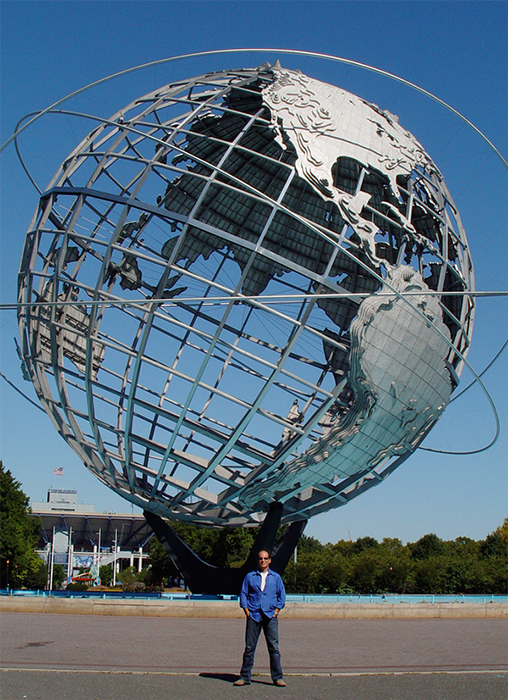
Lon Kirschner at The Flushing Meadows-Corona Park Unisphere (Courtesy of Lon Kirschner)

I love this guy’s work.

I “met” Lon Kirschner through author Marc Schuster, who had just published his novel, The Grievers. In my review of The Grievers, I had said, first line out of the gate,  “He had me at the cover.” And that was true. As soon as I saw the cover, I knew I had to read it, so I contacted Marc, and later Marc had connected me with the cover artist, who was Lon Kirschner (Lon works with his wife and business partner, Nancy Potter; examples of  his work are included in this interview). I’d since come to discover his website (Kirschner Caroff) and some of his work , we traded e-mails, and I thought, what a cool guy. Lon had told me that my review was the first time he’d ever been mentioned in a review. That kind of startled me. I thought—heinous! But the way his Grievers cover grabbed me shows the power of a well-made cover. I knew absolutely nothing about the story at that point (you know, we see covers first), but figured the “tone,” the message of the cover, was so superbly crafted that the story had to be well-written and quirky (I was not disappointed)! Covers get all kinds of boon and bane, why aren’t cover artists more frequently discussed—interviewed? That’s when I decided I had to interview this guy.

Lon could you give us a short bio on yourself?

My favorite bio is by Charles Davis, a wonderful author (who coincidently, I have done several

In Pinelight, by Thomas Rayfiel

covers for).  His bio reads:  “Charles Davis was born and educated, and has traveled and worked. He now lives and writes.”

Taking his lead, here goes:  Lon Kirschner was born and educated, and has traveled (a bit) and works (and works).  He now lives (thankfully) and designs.”

Hmm… I suppose you want more.

I was born in Queens, NY. A short walk to the 1964 World’s Fair grounds. The Unisphere is without a doubt my favorite piece of NY architecture. Growing up I loved to draw and knew that art was something I wanted to do. This was in spite of a crabby elementary art teacher telling me that even though I was good in art didn’t mean I could make a living at it. So much for early education!

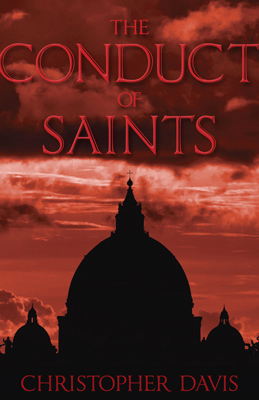
The Conduct of Saints, by Christopher Davis

I applied to several art colleges with my dream choice being The Cooper Union. A wonderful school with a long history of producing extraordinary designers and illustrators (what was I thinking?). Upon acceptance, each student was presented with a 100% tuition-free scholarship (what was I thinking?), a legacy that has existed since 1859 but is now sadly changing due to a difficult economic climate.

To my utter surprise I was accepted!  After graduation I started as a lowly studio assistant and worked my way up to a slightly higher level of lowly studio assistant at a small boutique studio in New York City. After 3 years I felt it was time to strike out on my own. I gave up a steady paycheck and began freelancing. After several years I joined with my old employer and we ran the studio together. Over the years, he played less of a roll until he retired.

I met my wife Nancy Potter, who was working at the studio when I returned. Together we have maintained the business as partners and have adapted to the vast technological changes in the industry.

When and how did you get into graphic design? Was it something you just always knew you wanted to do? Does artistry run in the family, and if so, how far back does it go (I love histories!)?

When I first got into the business, I wanted to be an Illustrator. I found typography a bit overwhelming and thought that it would be

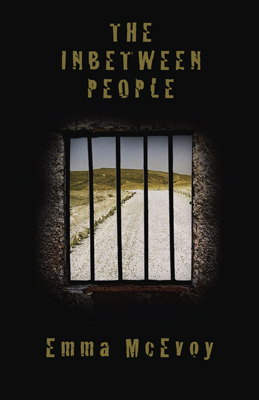
The Inbetween People, by Emma McEvoy

nice if all I had to do was draw pictures.

Reality set in, I needed a steady paycheck to cover my bad habit, playing drums in a rock and roll band. This required paying for rehearsal studios and gas to get to and from rehearsals and gigs. We were getting paid but you can’t pay bills on “all the beer you can drink.”  When it looked like the big record deal wasn’t happening it was time to move on and start building my career in art.

My day job was at a studio that produced graphics for a very broad group of clients, including assignments for movie campaigns, corporate identity, logos, packaging and publishing. I had learned a great deal and my typography phobia was alleviated. I was ready to put down my drumsticks and concentrate on graphics.

You asked about artistry in my family. My mother’s sister is a very talented person. She was a singer and also paints, draws and works in various media. If there was a connection to anyone in the family as far as “art” is concerned I would say that is it, but it all depends on what you consider art. My grandmother and mother were fantastic cooks. They could open a refrigerator (I would see an egg and some capers) they would see the makings of a five-star meal. When I think back on that there was definitely an element of art involved. Art can come from anywhere.

Excellent point, Lon! “Art” is not just about graphics and typography…it’s also about eggs and capers! What is your earliest memory of the first manifestation of your talent?

Drawing pictures with my friend in first or second grade. Cowboys and Indians and army battles. Other kids played them, we drew them.

Love that last sentence! What medium do you prefer to work in?

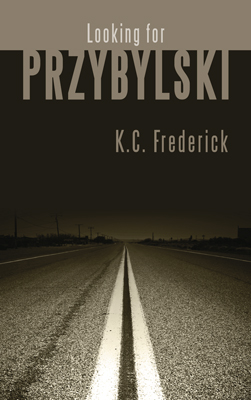
Looking for Przybylski, by K. C. Frederick

When I started in the business, it was all paint, pencils, rubber cement and razor blades. I was big on airbrushing but not so big on wearing my protective mask. Refer back to my answer for the bio question “He now lives (thankfully),” I must have inhaled gallons of dyes, acrylics and whatever else I could manage to spray. I was young and didn’t think about it.

Now it is all computer. It’s great to be able to set my own type, composite photos, produce comps that look printed and send files all over the world. The bad part is that many people (dare I say clients) think changes are simple and can be made at a moment’s notice. This gets into the whole concept-versus-production question. Don’t get me started. I see in the later questions that I will get my chance to state my case. If I sound to whinny, feel free to edit. No one will know (except me).

When and how did you get into book covers?

When I started freelancing, a friend of mine from college was working in the art department at Simon and Schuster. She told me I should come up and meet the art directors that gave out the assignments. I looked through their catalog and picked a few titles that I thought had less than inspired covers and redesigned them. I went up with my new book cover portfolio and landed some assignments. Most of these were in the “How To” genre, but I was happy to get the work. Another friend was working at Viking/Penguin. She invited me up to meet the creative director. I brought some of my airbrush paintings with me. He liked the work and handed me a rather long manuscript for a new book by an unknown author. The book was The Broom of the System, the first novel by David Foster Wallace. I did the cover illustration, the type was handled by their in-house art director. The cover was produced simultaneously as a dust jacket for hardcover as well as a paperback. I have the paperback, the hardcover was a limited run of 2,000. You can find them on ebay selling for fairly high prices.

How cool! You have pedigree! Could you describe your process for creating a cover?

An Unattended Death, by Victoria Jenkins

My design process for a book cover is fairly simple. I read the entire manuscript, if it is available. I then think about it for a while and then I start working. Many times where I started is not where I wind up. There have been happy accidents that take me in a whole new direction. The basic concept may be the same as when I started but the visual is totally different than what I originally had in mind. The truth is, most often than not I get an idea somewhere along the way, as I am reading. If it comes early I keep reading because there is always the chance that the idea won’t work out. People have commented to me that I really don’t need to read the entire book, a brief will do. Sometimes that is true, but I find more often than not ideas that come from a full manuscript would never have materialized if I had just read a few descriptive paragraphs. Books are like people, you need to go the distance before you really know them.

My goal is not to illustrate a particular scene in the book, but to convey a sense of what the book is about.

I’m quite impressed. So much of today is hurry up, do it yesterday, speed x 3! It’s nice to see you put in the in-depth interest, analysis, and effort. I’ve heard of so many dissatisfied authors, when it comes to their covers….

Okay, Kirschner Caroff is a full service graphic design and consulting company. You’re not “just” about book covers. You do all kinds of work: packaging, “corporate identity” work,  movie posters, logos—can you explain a little about them, and if the processes for any of them is any different between them?

As a small studio we tend to “specialize” in all types of work. I have learned over the years that basically all design projects share

Death in a Wine Dark Sea, by Lisa King

something in common. If they are going to be successful, they need to be built on a concept. Of course execution is important, but if the concept is lousy, the best execution won’t make it a good design. In our digital world where everything and anything is possible I feel that this crucial concept is sometimes forgotten.  My philosophy is keep it simple, keep it focused. Communicate in the least complicated way you can. We are in the business of communication. If your audience doesn’t get the point, you failed. It would be like writing a book in Russian for an English speaking audience.  Not everything needs a special effect. In fact, in a world gone special-effects crazy, sometimes it is the simple things that make the greatest impact. I am all for effects and digital magic if they enhance the design. We all know you can put a monkey’s head on a man wearing a suit and make it look real. If that’s the right solution for the job go for it. If not, rethink it. I myself have put a few weird things in a suit, but I think I was justified.

Less is more! That was one of the reasons your cover for The Grievers really grabbed me! Such powerful subtlety! Is there a different process when working with a publisher than when you directly freelance with an author?

The process of working with an author is very different than working with a publisher.  An author has a very personal relationship with their work. They have thought about it and worked on it for possibly years. They are so close to it that it is sometimes difficult for them to take a step back and look at it in a different light.

Many authors have  ideas that they think are perfect, but in reality they might not be the best solution. I listen and see if there is something I can use, but if not, I go my own way and do what they have trusted me to do. It usually works out. In fact I can say it

Elysiana, by Chris Knopf

always has worked out. I have had a few rough ones along the way, but in the end, solutions were always found. There have been times when an author makes a suggestion that takes a concept from being a good solution to a great solution. I try to leave my ego at the door and listen. If a suggestion is made that may work, I am happy to try it.

Publishers are easier because there is less emotion involved. The cover I am working on for them is one in a long list of projects they need to get done. There isn’t the same personal interests. When you work for a small press, many times the author does get involved. I have met some very extraordinary and wonderful people over the years, I actually consider it a benefit of the job.

Great point, the contrast between authors and publishers. How did you get to work for Permanent Press (or any other publisher)? Can you give us a list of some of the other publishers you’ve worked with?

I sent out a printed mailer to about two hundred publishers that looked interesting. Mostly fiction. Martin Shepard (Permanent Press) called me in response to the promotion. We had a great conversation, he explained he was a small publisher and probably couldn’t afford it. I asked him what his cover budget was. After he answered I told him he was right, he couldn’t afford it. The problem was I got such a good feeling from him that I made him a proposal. I told him if he could send several books from his list I would do it. The old make-it-up-in-volume approach. He agreed and that was the beginning of a twenty-plus-year relationship. As the years went by, I got more books per list. I am now the de facto Permanent Press Creative Director/Art Department.  I now do around sixteen books a year for them.

Over the years I have worked for Bantam/Doubleday/Dell, Simon and Schuster, Viking/Penguin, Paragon House, Northwestern University Press, Aldin DeGruyter and a host of smaller independent publishers.

What’s your typical work day like?

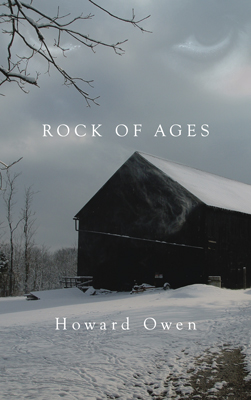
Rock of Ages, by Howard Owen

There is no such thing as a typical day. You can sit down to work and think you have your entire day planned and then the phone rings and everything goes out the window. It’s the nature of the beast.  Feast or famine.

Rock and roll! Are there other forms of expression: a) you’re already doing, and b) you’re not, but would like to do?

My first love was illustration, but I seem to have gotten further and further away from it. A lot of the solutions tend to be more photo illustration. I would like to get back to doing artwork in a more traditional manner, or maybe a combination of digital and traditional. I still dream of doing an illustrated children’s book. It doesn’t even matter if it sells. Just completing that goal and having it done would be a very satisfying experience. I have several ideas and partially written manuscripts that no one has ever seen. It’s my secret. I love doing what I do, but having a book of my own would be very special.

Hmmm…ever consider indie publishing, or Creative Memories? I know a great Cover Guy…

What do you like to read, currently reading?

I like to read fiction. Things that take me away from the everyday. I love mysteries. I am currently reading one by P. D. James. I also enjoy the broad sweeping historical novels. I have Sarum, by Edward Rutherfurd waiting in the wings. I read London and really enjoyed it. I actually was reading it while we were on a UK family vacation last summer.

What do you feel is the [real] impact of cover art [on readers? Publishers? Buyers? Authors]?

Many years ago the creative director of Bantam books told me that if he could get a person to pick a book up in the store based on the

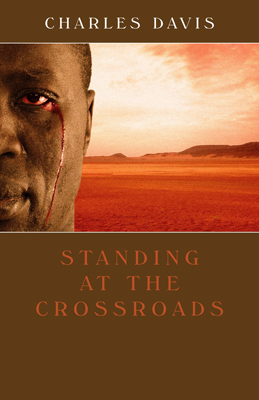
Standing at the Crossroads, by Charles Davis

cover then he had done his job. He couldn’t walk that person to the cash register, but by getting them to pick the book up the first part of the buying process had begun.

In the digital age the concept is the same, you still need to grab a reader’s attention. This is what authors and publishers expect and want. I feel covers are just as important now as they ever were, maybe even more so. Delivery methods come in all forms, but whether it is print, tablet, computer screen, or e-reader, a cover still needs to be impactful and compelling to the reader. If this weren’t true, all you would need for a cover would be a black-type title on a white background. A book cover is part of the whole package. It is the package. Sometimes the first impression a reader will have of a book will be based on the cover.

The internet has changed the way we buy books. When I am at an online site to buy a specific book, I very often see a cover that looks interesting and click on it to get more information. I have bought many books because the cover caught my attention. I may be a little more critical than others, but I think it works the same for everyone.

So, you can judge a book by its cover! How many projects do you have going on at any one time?

It varies. Right now I have about 13 or 14 books that need to be finished by the end of the summer in addition to some other corporate

work. The problem has always been that you think you will get to something and then another project with an earlier deadline comes in, you have to put something aside to get another project out the door. It’s all about time management. I am proud to say, the studio has never missed a deadline. We’ve missed some sleep, but never a deadline. This is a service business. You can do great work, but if you miss the deadline it doesn’t matter, you’ve produced the greatest design that no one will see.

Go on, Lon, get Zen, in any way you feel necessary about your business/efforts/work!

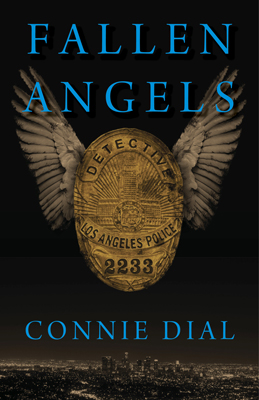
Fallen Angels, by Connie Dial

I love what I do. The wonderful part is that it is never quite the same. Each project is different and requires a unique solution. Some are not as exciting as others, but every project requires you to think differently. I don’t go to work every day and push the same piece of paper around. Some days are harder than others but that is probably the same for everyone no matter what they do. I produce something that is unique to me.

I still see things I designed years ago; it’s a very satisfying feeling. This past year we received an inquiry from The Canadian Museum of Civilization asking about using the cover art from The Magic Island as part of an exhibit on Voodoo. It is running now at the museum and will then travel throughout North America. That was a great feeling. I painted that cover many years ago using airbrush and traditional production methods. It won a Society of Illustrators award the year it was produced. After all the time that has gone by it’s exciting to see it have a new life and still remain a relevant design.

I am always happy to speak to people about possible projects. It’s part of what makes this exciting. You never know what the next call will bring.

Lon, if you were to have a gravestone, what would you have engraved upon it?

I hope I will have a gravestone or something to let the world know I was here. I think it would read:  “There’s never enough time in the day.”

Thanks for your time, Lon! And I look forward to working with you on the cover for my next release, ERO!

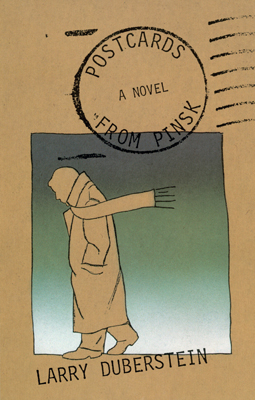
Postcards from Pinsk, by Larry Duberstein. First cover Kirschner Caroff did for Permanent Press
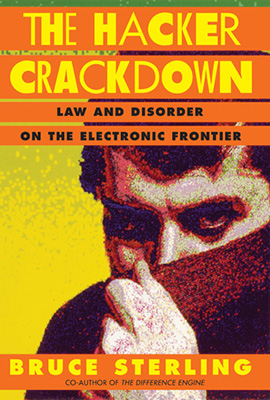
The Hacker Crackdown, by Bruce Sterling. First PC-generated Cover by Kirschner Caroff.

And…he had me at the cover:

The Grievers, by Marc Schuster. My introduction to the
The Grievers, by Marc Schuster. My introduction to the world of Kirschner Caroff!

To contact Kirschner · Caroff Design Inc., for freelance:

Phone: 518/392-3823

E-mail: info@kirschnercaroff.com

Website: http://www.kirschnercaroff.com/section-pages/contact.html

Filed Under: Book Covers, Fun, Leisure, To Be Human, Writing Tagged With: Art, Book cover, Books, Cooper Union, Cover Art, Cover Artist, Graphics artist, Kirschner Caroff, Lon Kirschner, Nancy Potter, New York City, Queens, Unisphere, Visual Arts

Footer

Upcoming Events

Events

Heading To

COSine 2026 – January 23 -25, 2026

Mountain of Authors – Unable to attend in 2026

MileHiCon58 – October 23 – 25, 2026


Follow Me

  • Facebook
  • Instagram
  • Pinterest
  • WordPress.org

Copyright © 2026 · Author Pro on Genesis Framework · Powered by WordPress.com. · Log in