• Skip to main content
  • Skip to footer

F. P. Dorchak

Speculative Fiction (New Weird) Author

  • Home
  • Books
    • What Readers Are Saying
  • Short Stories
  • About
  • Blog
    • Runnin Off at the Mouth
    • Reality Check
  • Events
  • Contact

The Grievers

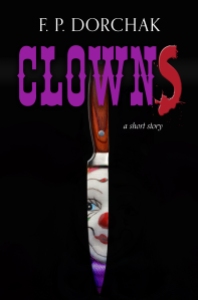
Kirschner Cover Art: "Clowns," by F. P. Dorchak

April 4, 2016 by fpdorchak

"Clowns," © F. P. Dorchak and Lon Kirschner, 2016.
“Clowns,” © F. P. Dorchak and Lon Kirschner, 2016.

Okay. Yes. I know…shameless, shameless self-promotion!

But I’ve wanted to talk about this cover since I first laid eyes on it…or it had laid eyes on me….

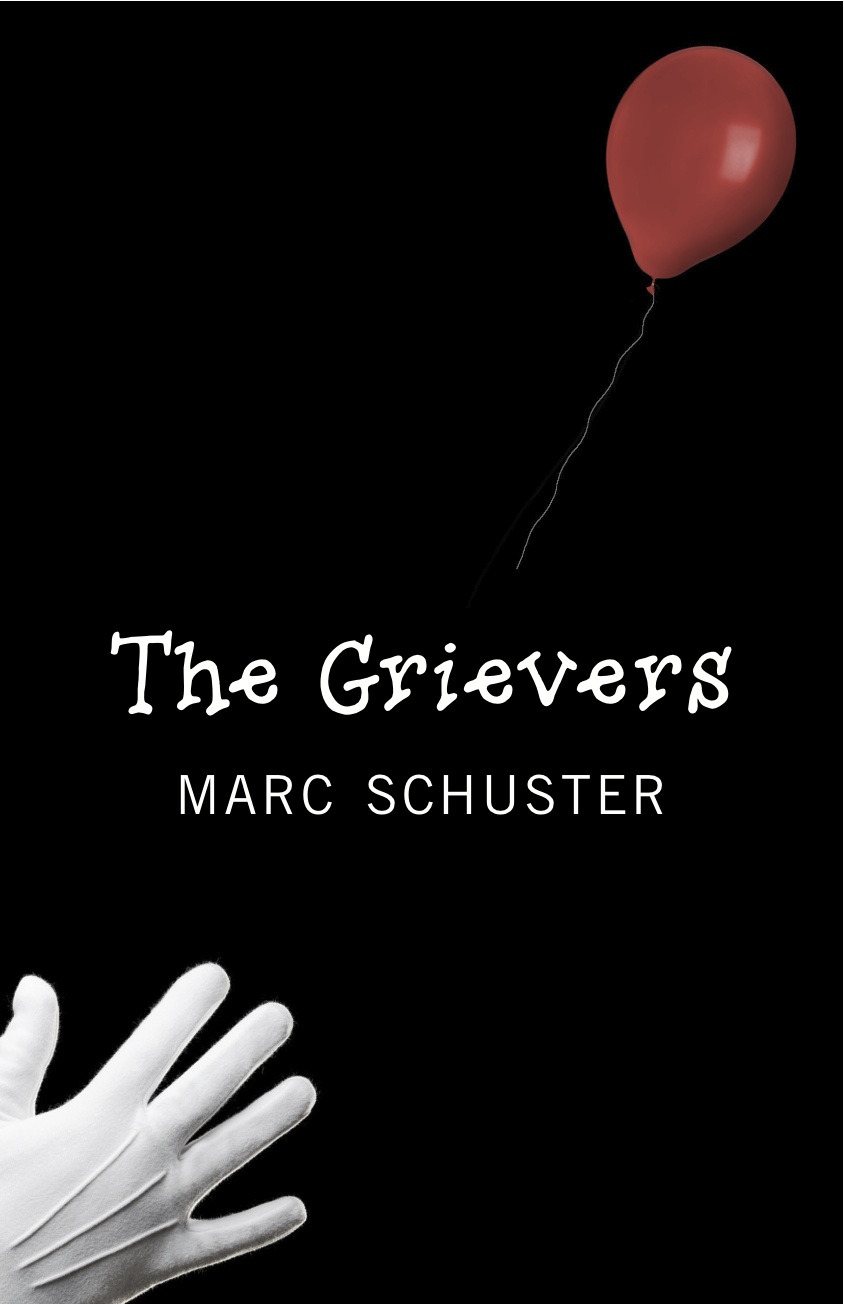
As I’d previously mentioned, I’d been (and still am) messing around with short stories, and had come across this one and decided to published it as its own stand-alone story. So, I turned to Lon Kirschner, who’d done a couple of my other covers. As always, Lon turned out a fantastic cover! It even reminded me of The Grievers, the cover he’d done for Marc Schuster, back in 2012 (and also involving clowns, by the way).

So, of course I want to talk about it!

When I first opened the file and looked at it, the very first thing I saw was the clown’s face…and I thought, ewwww…how frigging creepy! But…why is it starting at me through a slit?…a narrow opening…a…waaait a minuuute—

BOOM!

It hit me, just like that—the clown was staring at me from the blade of a knife!

I bust out laughing.

How frigging perfect!

I was walking around the house with my tablet looking at this thing and laughing my ass off. I just couldn’t take my eyes off it! What a perfect cover for my short-short story! The creepy clown face, the purple from its little clown-doll outfit, the kitchen knife, the script of the title—including the red “S”—all on a black background, which to me symbolizes the night/unknown! It was such a clean, subtle, no-nonsense creepy (have I mentioned this?!) cover!

I mean, our clown…the silly little dresser-top doll…the subtle way it’s peering out at us from the shiny knife blade is just like how I believe these little bastards are peering out at us from our dresser tops! Oh-so slyly…are they…or are they just staring ahead with their lifeless, beady little eyes?

Of course they’re staring at us!

This is what Lon had to say about creating my “Clowns” cover—which, by the way, was the first time he’d ever created a cover for a short story—I think you’ll really get a kick out of this:

“It did creep me out. I don’t really mind real clowns (although they are a little odd) but clown dolls are what I really find creepy. I also find some other types of dolls creepy but that might be just me. When we were kids we had a set of Raggedy Ann and Andy dolls that my Aunt sent from her travels in Europe. They sat on the old radiator that was in the bedroom I shared with my sister when we were very young. I would wake up some times in the middle of the night and I would see them staring at me. Like your story. I still think they moved.

“The other issue with this cover was I knew you had high expectations for this and I felt a little under pressure to produce something that hinted at the story but didn’t give it all away.

“I wanted it very, very simple but have that disturbing feeling. I went back and forth with the alternate “S” in ‘Clowns.’ At first I thought it was a bit cliché, but then I thought it was a good way to bring in that murderous element without being overly gruesome and it did offset that typical circus lettering.

“My own clown issues and creating a successful piece all combined to create something a little difficult to work on, but in reality, once I got going it all fell into place rather quickly.

“I always start with some sort of rough idea. I knew I didn’t want to see the whole clown face and I knew I needed a knife, I just wasn’t exactly sure how they would all meld together.

“This is how I have always worked. Some people sketch it all out exactly but that never worked for me. I do make little sketches on Post-it notes to sort some things out, but that is usually as far as I go. I find the fun in moving things around and making my adjustments on the fly. I think I moved the image of the knife over at one point about a sixteenth of an inch. Then I was satisfied!”

I love this line: “I still think they moved“!

I also like how Lon didn’t want to “give it all away,” which I could see might be a little difficult to do in a quick short short story of less than 800 (713) words! But, he did it, I’m proud of him and his result, and I am still beside myself over the cover!

So…I hope you’ll excuse me for analyzing one of my own, but I’ve been wanting to talk about it since I got it. With my next Kirschner Cover Art post, I’ll go back to talking about other author covers….

But…for now…sleep with one eye open!

Do you know where your knives are?

*******************************************

Lon Kirschner may be contacted at:

Phone: 518/392-3823

E-mail: info@kirschnercaroff.com

Book Cover Site: http://www.lonkirschner.com/

Related Articles:

  • Kirschner Cover Art: In Pinelight, by Thomas Rayfiel (fpdorchak.wordpress.com)
  • Kirschner Cover Art: Grace, by Howard Owen (fpdorchak.wordpress.com)
  • Cover Artist Lon Kirschner Interview (fpdorchak.wordpress.com)


Filed Under: Art, Book Covers, Fun, Leisure, Short Story, Spooky, To Be Human, Writing Tagged With: Clowns, Cover Art, Graphic Artists, Jesters, Kirschner Caroff Design Inc, Knives, Lon Kirschner, Marc Schuster, Short Stories, The Grievers

Kirschner Cover Art: Grace, By Howard Owen

November 13, 2015 by fpdorchak

Grace, By Howard Owen. Release Date October 2016, from The Permanent Press

Together with Lon Kirschner—who did my cover art for ERO and Voice—I’m launching a new series of posts that will discuss Lon’s cover art. I first ran into his efforts with The Grievers, a novel by Marc Schuster. Marc’s cover just grabbed me. Long story short, Marc put me in touch with Lon and I’d loved his work so much I’d commissioned him to do two of my covers. So, I thought, hey, why not highlight and discuss some of his work? So this marks the first in series of posts that will do just that. These may be bi-monthly…it may be quarterly…or it just may be whenever Lon and I can get-together to githerdone….

Today’s initial post is for Grace, by Howard Owen, which has an October 2016 release from The Permanent Press.

Originally, I was going to start out with another cover (but don’t worry, I’ll still get to it, and one of them is again another Howard Owen cover!), but as I reviewed the images Lon had sent, this one just jumped out at me. Continually. Maybe it was the key…maybe it was the desiccated wood grain behind it…maybe it was just having come off of Voice and the 1880s house I used as its setting…but it was probably all of it. When I looked at this cover over and over it was like I could actually feel that key…the rough, grainy wood. I have a key very similar to the one in the image from the Lake Clear, NY house I grew up in (that abovementioned late 1880s house served as the setting in Voice and ERO), and the wood in the image reminds me of the barn we had behind our house. How many times I’d run my hand over the barn’s weathered boards…caught a splinter or two…sandpapered it…painted it. Threw snowballs and rocks at it.

In short, it brought up all kinds of ancient memories. Memories that are getting ancienter and ancienter the older and older I get.

And isn’t that the point with cover art—or any artwork, for that matter? To illicit some kind of visceral experience? To trigger…a feeling? Any feeling?

To make us think?

Every time I look to this cover it slams me back to that barn. It’s darkened interior. It’s weathered and worn exterior. When I look at that key it takes me back to that house…to its original condition when we moved into it in the mid-to-late sixties before my dad gutted and reworked it’s interior. I am transported to that place and time…a displaced 1880s in my present time’s mind. I think I have wood splinters in my soul….skeleton keys in my heart. I had a great childhood there. Loved where I grew up. Think about it often. I incorporate so much of it into my work…and didn’t quite realize to what degree until I started publishing my novels over the past couple years….

But, that’s what Lon’s cover for Grace did and does to me.

Where it brought me—for good or ill—and whether or not my story has anything to do with Howard’s story behind that artwork…I don’t know—but, does it matter? If I saw this book on a shelf I’d pick it up and thumb through its pages and drink in its cover (in fact, I know I’d rub my hand over its cover, expecting to feel the wood grain, the metal key…).

Lon and I e-mailed back and forth a little about some of this, and here’s some of his responses:

“I had to smile when I read this [FPD: as in picking this cover as the first to discuss]. Grace is probably my favorite cover of the group and coincidentally, the easiest one to design. The manuscript had that Aha moment when I knew exactly what the cover would look like, it was one of those covers that ‘designed itself’ (referring back to my post on The Permanent Press blog).”

To this Lon also added about how the covers in this series of books:

“…organically morphed into a basically black and white design. When I did the first, I didn’t know it was going to be a series so that first cover is color and a bit more in the scary horror genre.”

The funny thing is Grace is not black and white…though Lon thinks of it as if it is!

Another funny thing is that I actually picked up on the above before Lon answered my question (i.e., that I figured he saw the cover as “black and white” even though it wasn’t; I mean, he could have said, “Yeah, I didn’t mean to write that, but…,” but he didn’t):

Me: Lon…but Grace is not black and white.

Lon: You are correct, Grace is in color but for me it functions as black and white. A dark background with a bright highlight. When I think of this cover, in my mind’s eye it is black and white. Maybe this is subliminal. You do raise an interesting point. I designed the cover and even I think of it as black and white. I guess we can persuade our mind to think of things very differently than what they are in reality. It brings to mind the story of police interviewing eyewitnesses to a crime. While all of the witnesses saw the same event, their stories and recollections can be very different. I didn’t even think twice when I referred to it as black and white.

Interesting isn’t it?

His reasoning is kinda “cousin” to my thoughts in the cover image itself. Our minds both went into tangential directions around the same cover….

And that’s a major point of cover art: to make you pick up a book. Purists (like me) will also say the point of cover art is to also give you something relating to the story, something to “hold” onto about the story within…[most traditional] publishers: they just want to get you to buy the damned thing.

Lon also went on to say that:

“Howard, who is usually fairly reserved, made a point of contacting me to tell me how much he loved the cover and thought it was spot on…has written me the most sincere and warm email about it.”

That—from my experience—is rare! We’re talkin’ tartare rare!

Most authors seem to take issue with their covers. Complain that many publishers “slap” on a cover with little to no thought incorporated. At least in the traditional publishing world. Usually a cover artist at a Big Five would get a brief description of what the book is about, maybe an outline, then they’d have to come up with something. Lon…is a different breed….and The Permanent Press is a different breed of publisher that allows Lon this “luxury”: Lon actually reads all of the manuscripts for the covers he does!

From Martin Shepard’s (head of The Permanent Press) June 17, 2015 blog post, Martin tells how he met Lon. Lon is not an employee of The Permanent Press, but is a “consulting creative director/designer.” This is how Martin remembers meeting Lon (and I do have Martin Shepard’s permission to use the following):

“Back in 1989, I received a flyer from Lon Kirschner and was mesmerized by his book cover designs. As I’ve said in a previous blog, I had my own art background. My beloved father, Mac Shepard, was an artist whose subway sketches are always featured on our catalog covers, while I was an art major at the High School of Music & Art in Manhattan during the late forties and early fifties. I was dazzled by his work, and Lon’s been designing covers for us for over 25 years. What a joy it is to both work with him and see what he comes up with. Any publisher, large or small, looking for a master cover designer would do well to get in touch with him by email.”

And that’s how I feel about Lon’s work: I am mesmerized…dazzled by it!

I am in awe of his work…which is why I’m highlighting him in my blogs. It all started with The Grievers, and it continues today (he did all my bookmarks and Voice book signing posters). In fact Lon told me that my review of The Grievers was the first time his cover art had ever been mentioned in a book review. I found that so hard to believe!

And if you haven’t yet read it, read The Grievers! It’s hilarious and had me laughing out loud so damned hard my mouth hurt. C’mon, Marc, write more funny stuff!

As I get to know Lon more and more through our correspondence these past couple of years, I am coming to find out what an absolutely terrific guy he is. We no longer just talk about writing and cover art or bookmarks and posters; our conversations have morphed into topics such as lawn mowing, trips, and movies. The man always tries to “do right” by his clients, and he’s so easy to work with. And, good God, is he talented. Maybe one day we will finally meet!

But for now, we trade e-mail, anecdotes—

And really cool covers!

*******************************************

Lon Kirschner may be contacted at:

Telephone: 518/392-3823

E-mail: info@kirschnercaroff.com

Site: http://www.kirschnercaroff.com

Filed Under: Book Covers, Fun, Leisure, To Be Human, Writing Tagged With: Art, Books, Cover Art, ERO, Grace, Howard Owen, Lon Kirschner, Marc Schuster, Marty Shepard, The Grievers, The Permanent Press, Voice

Marc Schuster…Renaissance Man!

June 7, 2013 by fpdorchak

Philadelphia, 1979: Marc Schuster commences work on his latest novel.

I met Marc Schuster, who had just published his novel, The Grievers, through the Internet. That is to say, I met Marc through the Internet—he did not, in fact, publish his novel through the Internet (that was with The Permanent Press). I forget exactly when and how, but I swear it must have been that he visited my blog and “Liked” one of my posts. As I always do, I check out those who leave a “Like,” because, well, I’m not famous, and only have a handful who do that, but that’s probably how I found out about him. At the time (this had to be in early 2011 or 2012…time has a way of warping for me…) he had not yet published The Grievers, and was asking for reviews. I checked out the book—was absolutely grabbed by the cover (and the quirky story)—and asked for a copy. Here is my review of it. Marc also devotes much of his life to promoting independent publishers, through his Small Press Reviews site. Anyway, ever since, we’ve interacted through blogs and e-mails (again, in either 2011 or 2012, I was listed as “Stalker” on his end-of-year stats WordPress publishes to it users), and I found him to be quite the “stand-up” guy (pardon the predictive pun; keep reading). Plus, he’s smart, and I like to hang out with smart people (or, I should say, I need to hang out with smart people). He’s also what I call, a “Renaissance Man.” I only know one other person I use that term with, and it’s my writer/producer/actor/blah-blah-blah brother, Greg…but, never mind him (for now). I’ve been wanting to get Marc and his bow ties on the “chopping block” for a while, so….

Marc, curious minds beg to know: do you sleep?

It’s funny—I used to have trouble sleeping, but I’ve gotten much better at it in recent years.

Could you give us a short bio?

I lived in Northeast Philadelphia until I was about thirteen, and then my family moved to the suburbs. This is actually turning out to be a significant detail in my life, as I’ve been meeting a lot of writers from that neighborhood lately. Shaun Haurin, who wrote the short story collection Public Displays of Affectation; Marie-Helene Bertino, who wrote Safe as Houses; and the indie-film producer Keir Politz all grew up within a few miles of my childhood home. We all focus on the same subjects in a way that I think has a distinct Northeast Philadelphia bent. Now I live in Havertown, which is a suburb of Philadelphia. Someone recently told me it’s “where the writers live.”

You teach writing and lit courses at Montgomery County Community College in Blue Bell, Pennsylvania. You write. Paint. Compose. Now, do podcasts. Got ADD?

Actually, yes. I was diagnosed in 2011. In fact, it’s taken me over twelve hours to answer this question.

Has writing always been in your blood? Has teaching? Have podcasts, painting, and compositions?!

Technically speaking, I guess podcasts haven’t always been in my blood, but I used to record radio dramas with my friends on a brown Fisher Price tape recorder when I was eight or nine years old. I’m sure that the tapes are floating around somewhere in my parents’ house. If I can find them, I might even start posting them when I run out of fresh material for my podcast. As for the other activities, I’ve always enjoyed art and writing. In fourth grade, I would write knockoffs of Doctor Who episodes. My hero was called “the Detective” and I distinctly remember that one of my stories was a recycled version of “The Robots of Death,” which I titled “The Killer Robots.” I probably spent more time drawing a picture for the cover than I spent on the story. As for teaching, I had a pretty strong sense that it was what I wanted to do from an early age if only to give me an excuse to wear a bow tie every day.

Interesting. Would love to hear those tapes! Marc Schuster: The Fisher Price Years….

Schuster Paris Interstice, 2010: Still at it.

So would I! I’ll have to try dig them up. Hopefully I didn’t record “Mr. Roboto” over any of them.

Dōmo arigatō. Okay, pretend you’re bellying up to the bar, Marc. What’s your pleasure? Do you prefer one activity over another?

I think that’s the problem—I enjoy them all. Or at least I enjoy one activity until I get bored with it, and then I move onto the next one. Fortunately, they complement each other. I’ll write until I hit a wall, and then I’ll paint for a bit, or work on editing one of my podcasts. The only part of my life where I can’t be so—flighty, I guess—is teaching, because the deadlines are always pretty tight. When you have sixty papers to grade, it isn’t a good idea to let them sit for too long. They need to get done.

What would you be if you weren’t a Renaissance Man?

Depressed verging on miserable.

So, see, there is truth to the urban legend that writers write to keep their sanity! It’s like, psychologists are actually trying to figure themselves out, and MDs “healing thyselves.” Themselves. You know what I mean.

Yeah, and I wonder if people in general would be happier if they were encouraged to express themselves in one way or another—or at least if it were considered less “odd” to engage in creative pursuits. So many hobbies in our culture revolve around collecting—which I see as a form of consuming. We don’t really encourage more creative hobbies. And a lot of the time I get the impression that people are shy or embarrassed when it comes to admitting that they have a creative side. So what we get is a culture full of people who bottle everything up and end up miserable because the overwhelming message of society is that happiness comes from accumulating more crap to fill the void rather than staring down the void and coming up with a creative way to express our feelings about it.

Totally agree! “Buy more!” “Keep up with the Joneses!” What’s your take on the current state of publishing? Or, perhaps, would a better question be on the state of reading?

You make an interesting distinction. As a business, I think publishing is in a state of unprecedented flux, and the people who want to make money in the industry are trying everything they can to turn a profit. I don’t think that this desperation helps readers, though, because the ceaseless hunt for blockbusters doesn’t allow big publishers to nurture and develop budding writers. That’s where small presses and independent publishing step in. For the most part, they recognize that what matters over the long haul is quality—however it’s defined. Growing an audience and developing a readership. One way to do that is through what I’d describe as a kind of curatorship in which publishers—and reviewers, to a certain extent—find writers whose work they enjoy and then promote their work to like-minded readers.

Interesting…now, you also make a nice distinction: how reviewers are part of that curatorship of developing writers. I don’t think that’s anything to sneeze at (I just sneezed a moment ago). We could do a whole “thing” on reviews, but in reading your reviews I find that, yes, they do bring new writers to readers (that is, your reviews do this; I’ve read other reviewers who are only out to rip others a new one, or prove how much more intelligent the reviewer is at the expense of the writer). It brings to mind how I like to think of social media: sure, authors can and should use it, but I think the real benefit comes from the readers who find someone they love (or hate) and “backyard gossip” them up.  Create the much touted “buzz.”

That’s the great thing about social media—and why I gravitate more toward “long-form” social media like blogging and podcasting rather than abbreviated platforms like Facebook. On a blog, it’s not only the case that you can go on at length about a new author you’ve discovered—or your favorite recipe, or a city you’ve just visited—but it’s also expected. Bloggers are ultimately sharers, and I feel like I’ve really gotten to know a few people online—people who are spread not only across the country but around the world—by following their blogs. (Yours, of course, chief among them!) And I hope that people who read my blog feel like they’re getting to know me.

You’re too kind, but thank you, sir. I definitely feel like I’ve gotten to know you much better over the past year of two. Given your erudite background, what’s your take on “today’s youth”? We constantly hear about the steady “dumbing down” of Humanity. I had recently heard the average global IQ level has dropped 3 points since the 1950s? Are Smartphones to blame? The Internet? Frank Dearborn?

Funny you should mention Frank Dearborn, since I think that one problem I have with education in recent decades is the way that it’s marketed. I can’t go anywhere without seeing a billboard for a college or university that touts things like ease and convenience. The basic message is that you can get a degree from home without ever getting out of bed. And then there’s the promise of financial gain, the idea that getting a degree from a particular college will provide you with the skills you need to get the job you want. Apparently the marketing experts aren’t consulting with the teachers, because as it turns out, earning a college degree involves a lot of hard work. More to the point, the purpose of a college education is not, in my opinion, to provide discrete job skills. It’s to give students perspective, to allow them to think about the big picture, how everything is connected, to develop a way of thinking that isn’t just a matter of ticking boxes and filling in forms. But that’s hard to sell, and it’s even harder to measure. Yet we live in a results-oriented society that wants to see one-to-one correspondence between time, effort, and money spent and return on the investment. The questions stops being, “How will all of this change the way I think about the world?” and becomes instead, “How will this particular thing you’re telling me right now apply to the job I want.” It’s a frustrating variation on “Will this be on the test?” I want to help students build systems of knowledge, ways of knowing themselves and the universe and how the two are related, and they want me to give them disconnected facts—trivia, essentially. Of course, I don’t blame them. They only want what they were promised.

“Promised”…or developed into? The Internet is Evil, commercials the Devil’s Candy, and movies are about exploiting sex, images of must-haves/must-bes, and whammy shots. As I look over your work…The Grievers, The Singular Exploits of Wonder Mom and Party Girl, The Greatest Show in the Galaxy, and Don DeLillo, Jean Baudrillard, and the Consumer Conundrum, they all seem concerned with consumerism in some way. Might that be your Moby-Dick?

It’s definitely a theme that fascinates me. I understand that business is business and that corporations need to sell products and services in order to keep the economy strong and give people jobs, but I also worry about what the constant drive for higher profits—a quest for the white whale if there ever was one—is doing to us. Everything gets boiled down to a commodity. I mean, I even hear it among some of my writer friends. They don’t talk about the books they’re writing. They refer to them as properties. I mean, really? Properties? And then there’s always talk about building a platform as a writer and branding oneself as a writer—and that gets right to the heart of my worries about consumerism. We’ve absorbed so much from the world of marketing that we’ve come to think of ourselves as commodities.

Do not get me started! You seem to tend toward the quirky, if I “read” your Small Press Reviews correctly. Does this bear itself out in your everyday life? Are you quirky, Marc? Give examples. Support your thesis.

I think I have an appreciation for quirkiness and a quirky sense of humor, but my life is fairly predictable. Gustave Flaubert once said that writers should be regular and orderly and live bourgeois lives in order to be violent and revolutionary in their work. I’ve more or less taken that to heart but substituted “quirky” for “violent.” When school is in session, I wake up at 5:15, get dressed, eat a bowl of granola, and head out to work. On weekends, I grade papers, mow the lawn, do laundry, and make enough granola for the coming week. Every two weeks, I buy three pounds of rolled oats so I can make more granola. Basically, my life revolves around granola. And bow ties. I really wish I had more occasions to wear bow ties.

I’ve always wanted to use “Flaubert” in a sentence. What’s your typical day like? Are there even 24 hours in it? I think you run on 27.

I guess it depends upon the day, but a few things remain relatively constant. I’ll usually have a cup of coffee in the morning—or two at most—before switching to decaf. I’m like Karl Childers in that respect. Too much coffee makes me nervous. When I’m teaching, I’ll meet with my classes and attend to other school business throughout the day. When school’s out, I’ll try to get as much writing done as I can in the morning, and then catch up on my reading in the afternoon. After dinner, my wife and I will usually go for a walk. All of the other work I do happens in the interstices—whenever I get bored or restless. Which is fairly frequently.

Dammit, you made me look up “interstices.” See, I really do need to be around smart people, not smartphones. You’re “living the dream”! But I think you touch on an important point…restlessness. The restless mind. I think this important for the writer mindset—heck, Humanity, if you get right down to it. Do you really get “bored,” or are you just always looking for the next curiosity?

I don’t know if I always go looking for the next curiosity. A lot of the time the next curiosity finds me. Maybe that should be a corollary to the saying about opportunity. When curiosity knocks, open the door and let it in.

Every time I answer the door, I find a burning paper bag before me. Are there other forms of expression: a) you’re already doing, and b) you’re not, but would like to do?

I like playing music. I do some recording from time to time, but I find that it eats up a lot of time. I can spend hours on a thirty-second piece of music, and then I start to obsess over all of the other things I could have been doing in that time, so sometimes I’ll just give myself an order not to record any music until I’ve completed another project. For example, I’m working on a new book, and I’ve given myself a pretty strict and somewhat unrealistic deadline for it, so I’ve decided not to work on any music of my own until the project is done. If someone else calls me up and asks me to play on a recording, that’s a different story, but for now, I’m doing my best to resist the sirens.

In terms of what I’d like to do, I’ve always wanted to try my hand at standup comedy, but the prospect of tanking is too daunting. The unfortunate result is that whenever I get in front of an audience at a reading, the majority of my allotted time goes to testing out material I would have tried at a comedy club.

Okay, didn’t see that coming. Was trying to envision what you’d say. I failed.  Funny thing is (pardon the paronomasia—see, you’re rubbing off on me already!), I can really see you doing this! Your dry delivery. That voice. You come out on stage all “professored up,” sporting white gloves and holding a red balloon—you never acknowledge nor draw attention to the gloves or balloon, but you hold on to said balloon the entire time, switch hands, tie it to the nearby stand as you juggle and deliver your deadpan. Then take your balloon and leave. I’d pay.

That sounds a lot like my approach to teaching, so I’m glad to hear that my students are getting their money’s worth.

I don’t even want to ask how many projects you have going on at any one time….

It’s hard to say. I’ve never really done a complete inventory. Usually I’ll have about two or three unfinished novels on my hard drive at any given time, along with a handful of ideas for essays and short stories. Projects like these tend to loom over me for years, but that’s how I maintain the illusion of productivity. I’ve been working on the book I want to finish this summer since, I think, 2008. It’s been through at least three very different drafts, each with a completely different cast of characters, and they’ve all fallen by the wayside before I’ve managed to complete them. In the meantime, I was finishing projects that had been going since years earlier. I think I’d been working on my “first” novel since 2003 when it was initially published in 2009, and I actually started The Grievers a year earlier, in 2002. Meanwhile, I’d been working on my dissertation from about 2002 to 2005—and then I worked on it some more when it was going to come out as a book, and somewhere in there I squeezed in work on the Doctor Who book, which was my first. So, really, I’m just always juggling projects, and the fact that every now and then I complete one makes it look as if I’m producing a somewhat steady stream of work, when in reality nothing could be further from the truth. Everything else—the short stuff—is just there to keep me busy when I get stuck or bored with the big projects.

In stitches…interstitial…intersteecees…is there anything else burning inside with a need for expression?

At the moment, I’m just trying to do as much as I can in the time allotted to me.

Well said. If you were to have a gravestone, what would you have engraved upon it?

Life is good.

Thanks for your time, Marc, always a pleasure and quite enlightening!

The pleasure was all mine! Thanks!

Find out more about Marc, at:

Marc Schuster’s website:  http://marcschuster.wordpress.com/

Marc Schuster’s Small Press Review:  http://smallpressreviews.wordpress.com/

Filed Under: Comedy, Fun, Leisure, To Be Human, Writing Tagged With: Arts, Don DeLillo Jean Baudrillard and the Consumer Conundrum, Marc Schuster, Montgomery County Community College, Northeast Philadelphia, small press, The Greatest Show in the Galaxy, The Grievers, The Singular Exploits of Wonder Mom and Party Girl

The Grievers – Buy This Book!

May 15, 2012 by fpdorchak

The Grievers launches today.

Read my review—BUY THIS BOOK!

Look at its cover. Pull up a chair and pour yourself a tall, cool one. Soak it in. Frame it up on a wall. Make it your skin, your desktop, the background on all your electronics. Your tramp stamp.

Buy yourself a pair of clown gloves and a red balloon. In fact, buy yourself an anthropomorphic dollar sign suit and walk your neighborhood.

I don’t care how you do it, but get this book.

That’s all I really have to say.

Related articles
  • The Grievers – By Marc Schuster (fpdorchak.wordpress.com)
  • The Grievers – By Marc Schuster (fpdorchak.wordpress.com)

Filed Under: Comedy, Leisure, Uncategorized, Writing Tagged With: Marc Schuster, The Grievers

The Grievers – By Marc Schuster

April 15, 2012 by fpdorchak

He had me at the cover.

I mean, isn’t it cool?

Black background…red balloon…white clown glove. What’s not to love?

And the title. The font of the title….

But, is the cover evocative of all kinds of quirky, impending highjinks…or merely a clever ruse to get one to buy his book?

The Grievers, penned by Marc Schuster (Permanent Press, May 2012) is about the loss of a sometime friend and how it affects one Charley Schwartz (who, despite what everyone seems to think, is not Jewish…), a conflicted, angst-ridden human dollar sign for an unnamed bank of somewhat regional repute, champion of correct-and-proper apostrophe use, who’s (checking…checking…) actually a sarcastically quick-of-wit doctoral student (not) working on his thesis, and who’s (still checking…) married to a wife in a constant state of quiet Freudian interior design demolition. To grow up or not grow up. Quit the job or not quit the job. Move forward…or continue allowing oneself to be inexorably run over by life’s daily and unrelenting–even dark–minutiae.

To be utterly blunt if not politically incorrect, this book had me laughing my ass off. I laughed so hard my eyes watered and several times had to temporarily suspend reading. My wife even pulled out the camera and recorded me in the throes of my literary hysterics.

Suicide–in and of itself–is no laughing matter, but it’s how the world responds to such Human Drama that can be the stuff of comedy–black or otherwise. Charley knew the deceased (Billy–his name’s Billy Chin). Well Kinda. They’d gone to prep school together, shared a dead cat in biology lab, as well as some twisted pop lyrics, as conveyed by another classmate…not to mention some shared looks at the deceased’s (Billy, his name’s–) stitched and razor-tracked forearm later in life. After the fact, Charley felt shame and remorse in not having been a better friend…in identifying nor taking action regarding his friend’s ultimate demise.

The Grievers was like watching a comedic train wreck. A miniature Theater of the Absurd. Mr. Schuster wove together the interestingly obtuse into a coherent and redemptive storyline that was a pure joy to read (and I don’t use the word “joy” much!). I enjoyed his words, their combination, their execution. The Grievers is controlled dysfunction. Keeping life safe and at arm’s length. Everything is a joke to Charley Schwartz until he embarks on his own form of revisionist history with the deceased (Billy Chin, dang it…). Yet, the book is not so much about all the individual events…the coming of age (at 28)…the seemingly utter bottom line of life (money)…friendship (or what friendship should be)…dissecting a cat named Fascia in biology class (and correctly identifying cat parts)…Marx Brothers, taking a flying leap, nor even  anthropomorphic dollar signs. It’s about what it is to be human. It’s about the gestalt effect of the whole…meshugaas…on individuals.

No. He’s not Jewish.

The Grievers is an enjoyable way to spend a Sunday afternoon! And–whether or not Mr. Schuster intended this–there’s also something altogether metaphysical about Charley’s daily entrapment within said anthropomorphic dollar sign, being constantly bowled over by the “traffic of life” onto a soggy and wet lawn (and is it “just” a soggy and wet lawn…or is it a metaphor for his own soggy and waterlogged life…), unable to pick himself up on his own. Always having to use others to get things done (not to mention verbally abusing them along the way…). You’d think he could stand on his own two feet…pull his own weight…somewhere…but that’d be asking too much. He’d rather make life difficult. Crack a joke or three. The whole thing’s rather stunted…passive/aggressive even…but it’s too much to ask Charley to grow a pair, because, well, he obviously has challenges in that department identifying the correct and proper body parts, as evidenced in prep-school biology lab.

Well…at least his heart’s in the right place.

Filed Under: Comedy, Leisure, Uncategorized, Writing Tagged With: Anthropomorphic Dollar Sign, Marc Schuster, Marx Brothers, The Grievers

Footer

Upcoming Events

Events

Heading To

COSine 2026 – January 23 -25, 2026

Mountain of Authors – TBD 2026

MileHiCon58 – October 23 – 25, 2026


Follow Me

  • Facebook
  • Instagram
  • Pinterest
  • WordPress.org

Copyright © 2026 · Author Pro on Genesis Framework · Powered by WordPress.com. · Log in